· 9 min read
Starting Strength Training Again? How to Make It Stick This Time

Colin Raney
Co-founder & CEO of Ray, NASM-CPT · Evidence reviewed October 25, 2026
Maybe your doctor told you to start lifting weights, or a friend won't stop talking about how much stronger she feels. Either way, you're probably not starting from nothing. Most people I talk to who are "starting" strength training have done it before, stopped, and are coming back. That's normal. In a 14-week study of 29 women who had just begun exercising, 66% had a lapse of at least a week. In a study of 5,240 gym members, 63% of new members stopped before their third month.
So the useful question isn't how to begin. It's how to make this time the one that sticks.
Direct answer: Train every major muscle group twice a week, with one or two sets of each exercise, stopping when you could still do two or three more reps. Keep the first two weeks light enough to learn the movements, then add a little every two weeks: a second set, then more weight, then a fixed schedule. What makes it stick is a handful of specific decisions about when, what and how much, and the right coach or app can make most of them for you.
Below you'll find how much training you actually need, an eight-week plan, the decisions that make it stick and how the main apps compare. At the end, I'll show how Ray, the AI coach we built, makes most of those decisions with you.
You've probably done this before, and it helps
What you did before isn't wasted. Women who trained for 20 weeks and then stopped for 30 to 32 weeks kept part of their strength: it fell, but not back to where they began. A review of 15 trials in middle-aged and older adults found strength stayed above where people started after long breaks, as long as they had trained longer than they rested.
Prior training may also help you build back. In a small study of young men, men gained more muscle in a second round of training than in the first. A larger trial of men and women didn't find faster regain, so treat it as a possible bonus, not a promise. Either way, starting again means relearning a habit more than rebuilding a body.
How much strength training you need to start
Less than most people assume. The American College of Sports Medicine's 2026 position stand, built on 137 systematic reviews, recommends training all major muscle groups at least twice a week. One set is clearly better than none, two sets are better than one, and training to failure isn't necessary. Stopping two or three reps short is enough effort.
The same guidance applies whether you've never lifted or you're coming back: ACSM's authors found training experience made little difference to the results. The US Physical Activity Guidelines agree that one set of 8 to 12 repetitions per exercise is effective.
You don't need many exercises either. ACSM's authors suggest four regions: upper-body push, upper-body pull, lower-body push and lower-body pull. A squat, a bridge, a push-up against a wall or counter and a dumbbell or band row cover all four in about 20 minutes.
An eight-week plan for starting again
Start lighter than you think. NASM, which certified me, starts most clients with one to three sets of 12 to 20 reps at roughly 50% to 70% of their maximum, and an ACE article on returning clients says intensity is the first thing to dial back. This plan is a coaching framework I'd use, built on that guidance, not a protocol from a single study.
Weeks | What to do | How it should feel | You'll know it's working when |
|---|---|---|---|
1 and 2 | Two sessions a week. One or two sets of 12 to 15 reps of each of the four movements, with a weight you could lift 20 times | Easy enough to focus on how you move | The movements feel familiar and you're not dreading the next session |
3 and 4 | Add a second set where you did one | Last few reps take effort, with two or three left in the tank | Both sessions happen on their planned days |
5 and 6 | Add weight once the top of your rep range feels comfortable | Challenging but controlled | Something you lifted in week one now feels light |
7 and 8 | Keep the same days and times. Swap in one new exercise if you're bored | Routine: less deciding, more doing | You'd notice if you skipped it |
Some soreness in the first week is common and should fade. Sharp pain, or pain that lingers in a joint, is a reason to stop and check with a clinician. Eight weeks won't make the habit permanent: in one study of new habits, becoming automatic took anywhere from 18 to 254 days. It gets you past the hardest part.
Make your training stick
"Start small" and "be consistent" are true and nearly useless, because they don't tell you what to do on Tuesday. These are the specific decisions behind them.
- Pick a session you could repeat on your worst week. In a 12-week trial of 62 untrained older women, one set per exercise built strength about as well as three. On a bad week, the short version keeps the habit alive.
- Decide the day, time and place now. Plans that name when and where you'll exercise raise activity, especially when they include what you'll do if something gets in the way.
- Keep the same few exercises for a while. Among 111 new gym members, consistency and low complexity were among the strongest predictors of a habit forming.
- Choose the version you like. How good exercise feels while you're doing it predicts whether people keep doing it.
- Plan for the missed week. If a week goes badly, repeat it rather than pushing on. A week or two off doesn't erase your strength.
How the top strength apps handle your first weeks
You've probably heard of most of these apps. The question for a restart is narrower: which ones will help you through the first few weeks, and which will make them harder? In my view, what helps most is an app that sets your starting point and keeps adjusting as you go. What hurts most is being dropped into a plan at a set level and left to judge it on your own. Here's how each one handles that, based on its own pages and App Store listing.
App | What helps a restart | What makes it harder | Price, checked Oct 25, 2026 |
|---|---|---|---|
A clear program with a finish line, such as a 9-week bodyweight plan | It's mostly content. Progression is preset each week, so it won't adjust when a week goes badly | App Store lists $13.99 to $24.99/month or $134.99/year. Free trial on monthly plans | |
Polished classes and a low price, especially if you already wear an Apple Watch | You choose the classes and the schedule. There's no starting assessment and little that adapts to you | $9.99/month or $79.99/year, 1 month free | |
A fresh workout generated for your level, with weight or reps raised as you log | You get another workout, not guidance. Judging what's too much after a break is up to you | App Store lists $12.99 to $15.99/month or $79.99 to $95.99/year | |
A coach-written plan and a team to train with | You're dropped into the team's program at its level, so the first weeks back can be rough | From $29.99/month. 7-day free trial | |
A fitness assessment and a strength score, with a human coach on the coaching tier | The lower tiers are self-guided plans. The coaching price isn't published | App Store lists Caliber Plus at $6 to $12/month | |
A real personal trainer who builds and adjusts your program | There's a matching step before you start, and it's the most expensive option here | $50 first month, then $199/month | |
Coaches you through each session and adjusts every day, including when you're tired, sore or short on time | You need to be ready to give Ray feedback so it can tune and adjust for you. (It can't read your mind.) | $19.99/month, $39.99 every three months or $119.99/year. First week free |
Ray is our product. We describe it on the same terms as the others.
How Ray helps you re-boot
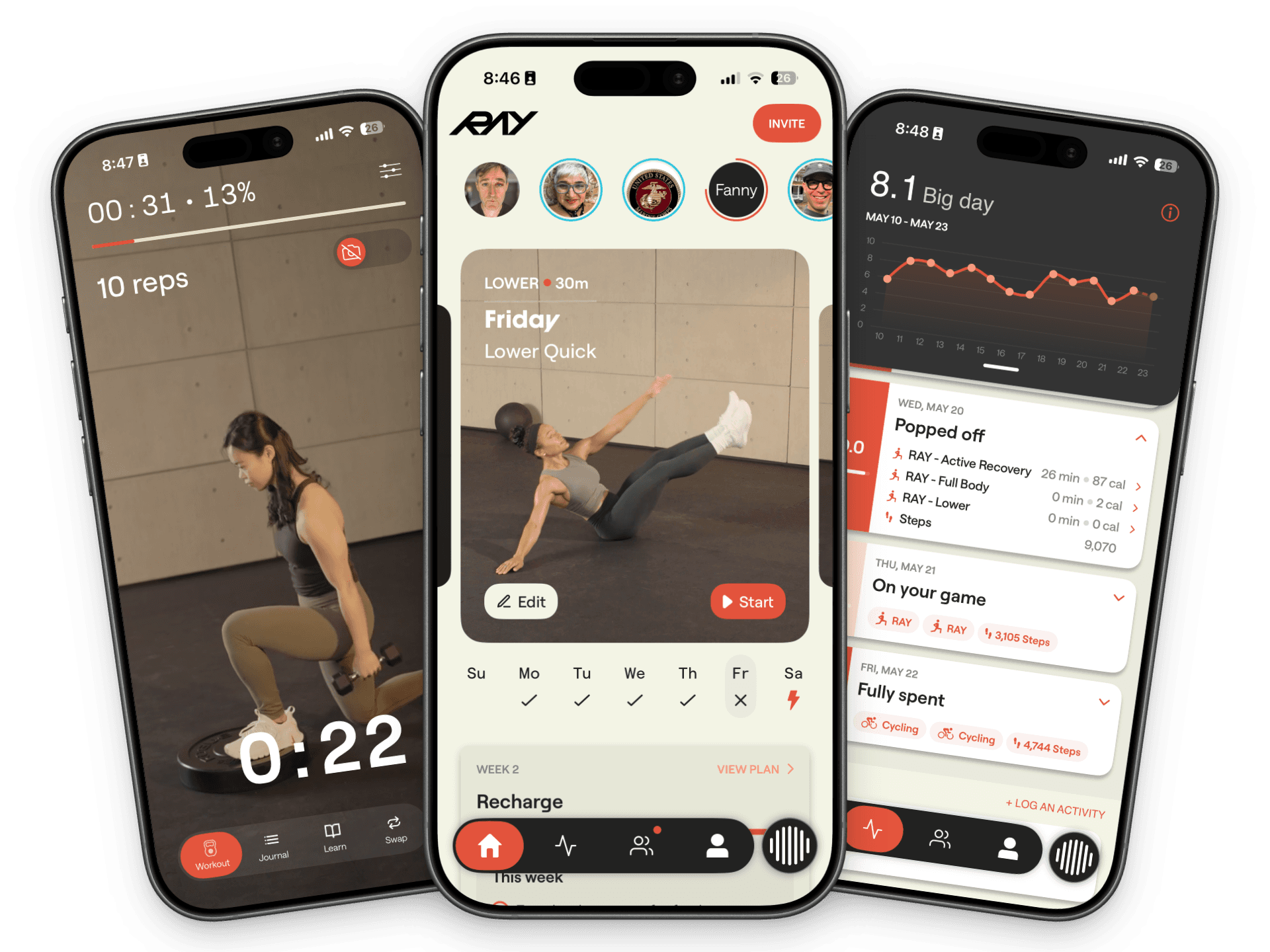
Ray helps you ease back into strength training by making most of the decisions above with you. It's an AI personal trainer that plans your week, coaches you out loud through each session and learns from every workout: your feedback, what you like and how you perform. In Ray's own words, it "changes the session in the moment, and remembers what worked."
The decision | On your own | With Ray |
|---|---|---|
Where to start | Guess at exercises and weights | Tell Ray your goals, what's in the way and any injuries, and it plans your sessions |
How hard to go today | Push through, or skip | Say you're tired or sore and Ray adjusts the session before you start |
When to add more | Judge your reps in reserve and decide | Ray counts your reps, times your rest and reviews and adjusts your plan every day |
Which days you train | Hope the week cooperates | Ray learns which days work for you and checks in before your workout, with optional text reminders |
What you'll enjoy | Stick with a plan you don't like | Ray learns what you like and builds stretching, mobility, conditioning and cardio around it |
After a missed week | Start over, or pretend it didn't happen | Ray adjusts your plan so you pick back up without starting over |
You keep the decisions that matter to you, like your goals and your days. Ray handles the rest, session by session. As Ray's site puts it, Ray "picks up where you left off, adjusted for where you are today."
Starting this week
Put two sessions on your calendar, pick the four movements and keep the weights light for two weeks. If you'd like a coach to make those calls with you, try Ray free for a week. It's on iPhone, and after the free week it's $19.99 a month, $39.99 every three months or $119.99 a year.
For the exercises themselves, see our complete guide to strength training after 35 and beginner's guide to fitness after 50.
Sources
- Currier BS, et al. Resistance training prescription for muscle function, hypertrophy, and physical performance in healthy adults: an overview of reviews. Medicine & Science in Sports & Exercise, 2026. PubMed 41843416
- US Department of Health and Human Services. Physical Activity Guidelines for Americans, 2nd edition, 2018. PDF
- NASM. Periodization training simplified. nasm.org
- Green DJ. How to overcome the reversibility principle and help your clients get back on track. ACE Certified, September 2024. acefitness.org
- Simkin LR, Gross AM. Assessment of coping with high-risk situations for exercise relapse among healthy women. Health Psychology, 1994. PubMed 8055862
- Sperandei S, et al. Adherence to physical activity in an unsupervised setting. Journal of Science and Medicine in Sport, 2016. PubMed 26874647
- Staron RS, et al. Strength and skeletal muscle adaptations in heavy-resistance-trained women after detraining and retraining. Journal of Applied Physiology, 1991. PubMed 1827108
- Yang Y, et al. Training session and detraining duration affect lower limb muscle strength maintenance in middle-aged and older adults. Journal of Aging and Physical Activity, 2022. PubMed 34510028
- Seaborne RA, et al. Human skeletal muscle possesses an epigenetic memory of hypertrophy. Scientific Reports, 2018. PubMed 29382913
- Psilander N, et al. Effects of training, detraining, and retraining on strength, hypertrophy, and myonuclear number in human skeletal muscle. Journal of Applied Physiology, 2019. PubMed 30991013
- Lally P, et al. How are habits formed: modelling habit formation in the real world. European Journal of Social Psychology, 2010. DOI 10.1002/ejsp.674
- Kaushal N, Rhodes RE. Exercise habit formation in new gym members: a longitudinal study. Journal of Behavioral Medicine, 2015. PubMed 25851609
- Cunha PM, et al. Resistance training performed with single and multiple sets induces similar improvements in muscular strength in older women. Journal of Strength and Conditioning Research, 2020. PubMed 30272625
- Bélanger-Gravel A, et al. A meta-analytic review of the effect of implementation intentions on physical activity. Health Psychology Review, 2013. DOI 10.1080/17437199.2011.560095
- Rhodes RE, Kates A. Can the affective response to exercise predict future motives and physical activity behavior? Annals of Behavioral Medicine, 2015. PubMed 25921307