· 9 min read
What Workout Apps Do After You Miss a Week or Two

Colin Raney
Co-founder & CEO of Ray, NASM-CPT · Evidence reviewed October 24, 2026
Missing a week or two is one of the most ordinary things that happens to anyone who trains. In a 14-week study of 29 women who had just started exercising on their own, 66% had a lapse of at least a week and 41% went three weeks without training. You've just lost your momentum, and you don't feel like opening the app. The trick is how to take the small steps to rebuild your momentum (and avoid beating yourself up in the process).
Direct answer: Most workout apps just deliver content, so not much happens while you're gone. Sweat, Apple Fitness+ and Nike Training Club keep your program where you left it, Peloton refreshes its weekly plan every Monday, and Fitbod expects you to lower the weights yourself. Future's human coaches check in. If what you lost is momentum, look for an app that reaches out, makes the first session back small and rebuilds the week around where you are now. A one- or two-week break doesn't erase your strength, so you don't need to start over.
The myth that you lose strength fast
Here's a big myth: miss a couple of weeks and your strength is gone. The data says otherwise. When researchers stopped 12 power athletes from training for 14 days, their bench press fell 1.7% and their squat 0.9%, changes too small to be statistically significant. In a study of 15 young men who were new to lifting, three weeks off produced no significant drop in muscle size or in their one-rep max bench press. In a 24-week trial, men who took three-week breaks between six-week training blocks ended up with muscle growth similar to men who trained straight through.
The scarier numbers you may have read come from immobilization studies. When young and older men had one leg immobilized for two weeks, they lost 28% and 23% of that leg's strength. A week off from lifting, while you're still up and walking around, isn't the same thing.
When strength starts to fade
Strength does fade if the break keeps going. A meta-analysis of 103 studies found losses grow as breaks get longer and are larger in people over 65. The short-break studies are small and mostly in young men. For middle-aged and older adults, a review of 15 trials found strength stayed above where people started after breaks of four weeks or more, as long as they had trained longer than they rested.
So after a week or two, you're not starting over. You're rebuilding the routine, not the muscle.
What each app does when you're gone
This table compares seven apps on the three moments that matter after a gap: whether the app reaches out while you're away, what it offers when you come back, and how the plan changes afterward. It describes what each company documents in its help center, product pages or App Store listing. "None documented" means we couldn't find it, not that it can't happen.
App | While you're away | First session back | Plan afterward | Price, checked Oct 24, 2026 |
|---|---|---|---|---|
Reminders an hour before workouts you've scheduled | The program week rolls over on Sunday whether you trained or not. You can pick a different week yourself. | You move the week back by hand | 7-day free trial. App Store lists monthly plans from $13.99 to $24.99 and $134.99 a year | |
Weekly streak resets with no grace period | You log the lighter weights you actually lift | Recommendations recalibrate after a few sessions | $15.99/month or $95.99/year, 7-day free trial | |
None documented | Personalized plans refresh every Monday | Peloton adjusts the plan around the days you train | App One $15.99/month or App+ $28.99/month on the App Store | |
Reminders when you start a Custom Plan | Go back and complete earlier days or weeks | Repeat the plan when it ends | $9.99/month or $79.99/year, 1 month free for new subscribers | |
None documented | None documented | None documented | Free | |
A human coach checks in | Your coach adjusts the program | Your coach adjusts week to week | $50 first month, then $199/month | |
Opt-in texts with coaching messages and workout reminders | Ray adjusts your plan so you can pick back up without starting over | Ray reviews and adjusts the plan every day | $19.99/month, $39.99 every three months or $119.99/year, first week free |
Ray is our product. We describe it against the same three moments and name where the others are a better fit.
Apps that keep the content playing
Sweat, Apple Fitness+, Nike Training Club and Peloton are built around content: classes, programs and libraries you dip into. That works well while you're showing up. When you leave, the content keeps rolling, and the app doesn't seem to notice whether you're there or not. Sweat's program week rolls over at midnight on Sunday regardless of what you finished. Peloton's personalized plans start fresh every Monday. Apple's Custom Plans hold earlier days for you to go back and complete.
Some of these apps call what they offer a plan, but none documents doing anything about your absence. Sweat's own blog suggests repeating a week or taking your program back a few steps yourself when you return. Deciding where to restart is your job, and so is finding the reason to come back.
That's fine if you like a big class library or a fixed program and you know you'll return when you're ready. If you only need the next class lined up, these apps do that well.
Apps that build one workout at a time
Fitbod is an excellent workout generator for people who already know how to lift. It designs each workout for the day you open it, taking into account which muscles are rested, so it doesn't know much about what happened while you were gone. Fitbod treats a muscle as fully recovered after six days, so after a week or more away, everything reads as fully rested, not out of practice. Its help article for people coming back tells you to log the weights and reps you actually performed if the recommendations feel too heavy, and says they typically recalibrate after a few sessions. Its weekly streak resets to zero with no grace period if you miss your goal.
For a self-directed lifter, that's reasonable. You know your numbers, you lower them for a session or two and you carry on.
If you're less sure what to change, the first session back is the one most likely to feel too hard, and that's exactly the session you need to go well.
A coach who notices you're gone
Future Pro is the one app here built around a person. Your coach checks in, monitors your progress and holds you accountable, and its help center says coaches adjust your program when travel, illness or a schedule change gets in the way. If you want a person who notices you're gone, Future is the most direct answer here. It's also the most expensive, at $199 a month after a $50 first month.
How Ray handles a missed week
Ray adjusts your plan when you miss a week, so you pick back up from where you are instead of starting over. Ray is an AI personal trainer that coaches you out loud through each workout. If you've opted into texts, it sends coaching messages and workout reminders and answers when you text back. Its App Store listing says that if you miss a session, Ray helps you reschedule and get back on track.
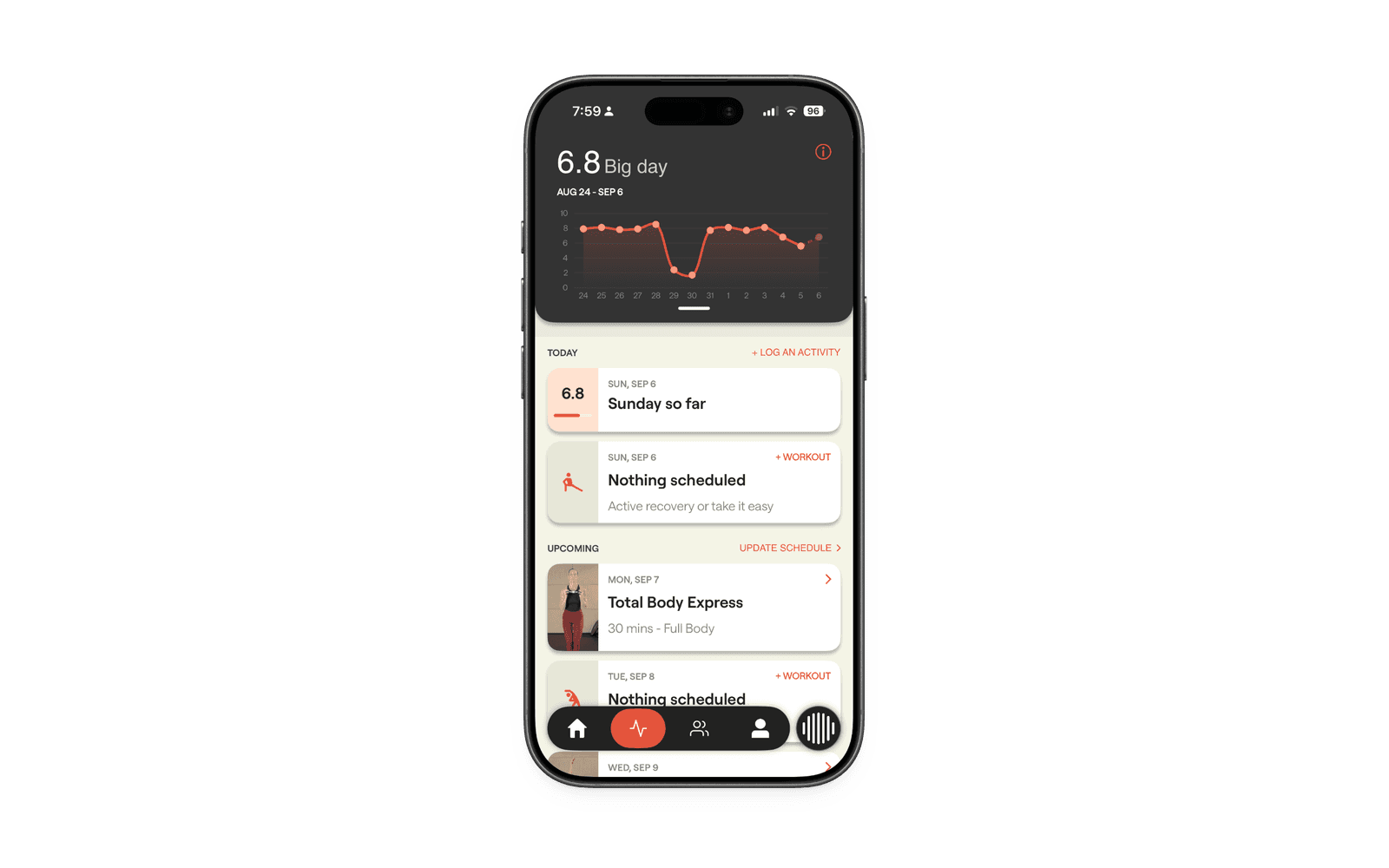
When you come back, you can tell Ray what happened in plain words: you missed a week, you've been gone a while, you want to get going again. Before any workout you can also say you're tired or sore, and Ray adjusts the session before you start.
A session with Ray doesn't have to be a full strength workout, either. Strength training is the foundation, but Ray also builds in conditioning, cardio, stretching and mobility. So the first step back can be a short stretching or mobility session, and the plan builds back from there.
Why a nudge and a smaller first step help
The best evidence on nudges comes from a megastudy of 61,293 gym members that tested 54 four-week programs. Forty-five percent of them raised weekly gym visits, by 9% to 27%. The top performer gave a reward worth about nine cents for returning after a missed workout, and lifted visits 27% compared with the control group.
But that program paired the message with a reward, and only 8% of the programs produced a change still measurable after they ended. In a six-week trial of 44 adults, walking suggestions raised steps over the next 30 minutes by 24%, but the effect faded as people kept getting them.
Habit research points the same way. In a study of 111 new gym members, keeping the behavior simple was one of the stronger predictors of building an exercise habit. In a 12-week study of new daily habits, missing one opportunity didn't materially affect how the habit formed. No study we found tests whether an app that re-plans brings more people back, so treat this as the reasoning behind the design, not proof of an outcome.
How to choose the best app for building a routine
The best app for building a routine keeps you going through the weeks that don't go to plan. Weigh how each app handles a gap as heavily as its workouts. The right choice does four things.
- It notices you've been gone. A reminder for a scheduled workout helps. A message sent because you stopped showing up is a different kind of help.
- It makes the first session back easier. If the app expects you to lower the weights yourself, plan your first session back to be shorter and lighter than where you left off.
- It rebuilds the week. A plan that rolls forward on the calendar can leave you at week five when you feel like you're in week one.
- You can tell it what happened. Saying "I've been gone two weeks" and getting a plan that fits is the closest an app gets to a coach.
If your app doesn't do these things, do them yourself. Pick the shortest session you can find, finish it and schedule the next one before you close the app.
Getting back in this week
If you've been away a week or two, your strength is very likely still there. What you need is a first session easy enough to start and a plan that picks up from where you are today.
If you'd like a coach that checks in and adjusts the plan for you, try Ray free for a week. It's on iPhone, and after the free week it's $19.99 a month, $39.99 every three months or $119.99 a year. If you'd rather keep a fixed program you'll pick up on your own, Sweat or Apple Fitness+ will hold your place.
For more on why routines slip and how to build one that lasts, read why you keep quitting your workout program and how AI fitness coaches adapt to real life.
Sources
- Simkin LR, Gross AM. Assessment of coping with high-risk situations for exercise relapse among healthy women. Health Psychology, 1994. PubMed 8055862
- Hortobágyi T, et al. The effects of detraining on power athletes. Medicine & Science in Sports & Exercise, 1993. PubMed 8371654
- Ogasawara R, et al. Clinical Physiology and Functional Imaging, 2011. PubMed 21771261
- Ogasawara R, et al. Comparison of muscle hypertrophy following 6-month of continuous and periodic strength training. European Journal of Applied Physiology, 2013. PubMed 23053130
- Vigelsø A, et al. Six weeks' aerobic retraining after two weeks' immobilization restores leg lean mass and aerobic capacity but does not fully rehabilitate leg strength in young and older men. Journal of Rehabilitation Medicine, 2015. PubMed 25898161
- Bosquet L, et al. Effect of training cessation on muscular performance: a meta-analysis. Scandinavian Journal of Medicine & Science in Sports, 2013. PubMed 23347054
- Yang Y, et al. Training session and detraining duration affect lower limb muscle strength maintenance in middle-aged and older adults. Journal of Aging and Physical Activity, 2022. PubMed 34510028
- Milkman KL, et al. Megastudies improve the impact of applied behavioural science. Nature, 2021. PubMed 34880497
- Klasnja P, et al. Efficacy of contextually tailored suggestions for physical activity: a micro-randomized optimization trial of HeartSteps. Annals of Behavioral Medicine, 2019. PubMed 30192907
- Kaushal N, Rhodes RE. Exercise habit formation in new gym members: a longitudinal study. Journal of Behavioral Medicine, 2015. PubMed 25851609
- Lally P, et al. How are habits formed: modelling habit formation in the real world. European Journal of Social Psychology, 2010. DOI 10.1002/ejsp.674