· 11 min read
Starting Fitness After 50: Your Complete Beginner’s Guide for 2026

Colin Raney
Co-founder & CEO of Ray, NASM-CPT
Direct answer: If you are starting fitness after 50, start with three priorities: build whole-body strength, walk or do light conditioning often enough to support your heart and energy, and keep mobility and balance in the plan from day one. The safest useful starting point for most beginners is not an extreme challenge; it is 3 short strength-focused sessions per week, easy walking on non-lifting days, and small progressions you can repeat.
A good first month should make daily life feel easier: standing up from the floor, carrying luggage, climbing stairs, keeping up with family, and feeling confident on vacation or during a long day out. If you have chest pain, dizziness, a recent surgery, uncontrolled blood pressure, a new neurological symptom, or a condition your clinician has told you to monitor during exercise, get medical guidance before increasing intensity. Otherwise, begin conservatively and let your body earn the next step.
What is the best way to start fitness after 50?
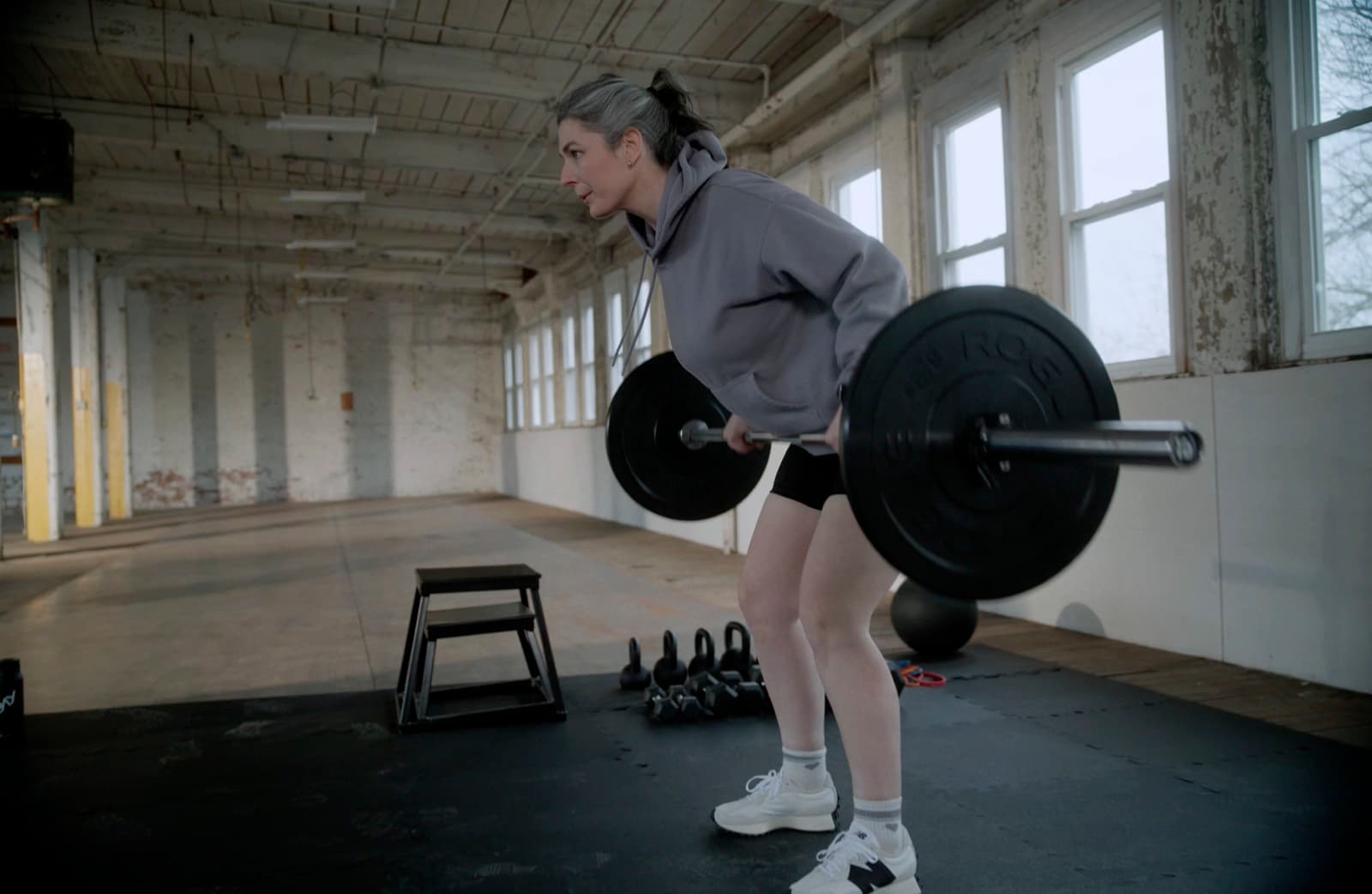
The best way to start fitness after 50 is to begin with strength training as the anchor, then support it with walking, mobility, balance, and recovery. Strength is the piece many beginners under-dose, yet it is the quality that helps you stay capable for the rest of your life.
The practical formula is simple:
- Strength train 3 days per week for about 30 minutes.
- Walk, cycle, swim, or do another comfortable aerobic activity on most non-strength days.
- Add 5 minutes of mobility and balance inside workouts instead of treating them as separate homework.
- Progress one variable at a time: reps, resistance, range of motion, or weekly consistency.
The CDC’s physical activity guidance for older adults recommends aerobic activity, muscle-strengthening activity, and balance work for adults 65 and older. The Physical Activity Guidelines for Americans also recommend muscle-strengthening activities for all major muscle groups at least 2 days per week. If you are in your 50s, you do not need to wait until 65 to use those categories; they are a useful framework now.
Why fitness after 50 should be about capability, not punishment
Starting over at 50, 55, or 60 can feel emotionally different than starting in your 20s. You may not care about chasing a gym identity. You may care much more about being mobile, whole-body strong, steady on your feet, and ready for the life you have been building toward.
That is the frame this guide uses. Fitness after 50 is not about pretending you are 25. It is also not about treating 50 as fragile or old. It is about training for useful capacity: carrying groceries without your back taking over, keeping up with children or grandchildren, hiking on a trip, getting through airport days, doing yard work, and feeling like your body is still on your side.
The fitness industry often gives people over 50 two poor choices: high-intensity plans that ignore joint history and recovery, or watered-down routines that assume you cannot build strength. A better plan sits in the middle. It gives you real training, but with smart exercise selection, gradual loading, and permission to adapt.
How much exercise do beginners over 50 need?
For a beginner over 50, the first target is consistency, not the maximum guideline number. A useful first month can be 3 strength sessions, 2 to 4 easy walks, and short daily mobility breaks. Once that feels normal, you can build toward the public-health targets.
Training type | First-month beginner target | Why it matters |
|---|---|---|
Strength | 3 days/week, about 30 minutes | Builds capacity for stairs, carrying, posture, and independence |
Aerobic activity | 10–30 minutes on 2–4 days/week | Supports heart health, energy, and recovery without crushing your joints |
Balance | 2–5 minutes inside each workout | Helps confidence, foot/ankle control, and everyday steadiness |
Mobility | 5 minutes before or after workouts | Keeps joints moving comfortably enough to train well |
Recovery | At least 1 easier day after each new strength session | Lets muscles and connective tissue adapt |
MedlinePlus exercise guidance for older adults, from the National Library of Medicine, points readers toward a mix of endurance, strengthening, balance, and flexibility resources. That is a better lens than asking, “Which single workout burns the most calories?” You are building a body that can do more things, not just survive a hard session.
If you want a guided plan that adapts to your time, equipment, and consistency needs, Try Ray free for 1 week.
What should a first-week workout plan after 50 look like?
Your first week should be easy enough that you finish feeling like you could do a little more. The goal is to learn the movements, identify any exercises that need modification, and create a repeatable rhythm.
Use this 3-day, 30-minute plan. Put at least one rest or walking day between strength days.
Day | Focus | Simple session |
|---|---|---|
Day 1 | Full body | Warm up: 5 minutes easy walk or march-in-place. Strength: chair squat or box squat, incline push-up, dumbbell or band row, glute bridge, dead bug. Do 2 sets of 8–10 reps each. Conditioning: 4 minutes easy step-ups or brisk walking. Stretch: calves, chest, hips. |
Day 2 | Upper body + posture | Warm up: arm circles, wall slides, easy walk. Strength: incline push-up, one-arm supported row, seated or standing overhead press with light weights, band pull-apart, farmer carry. Do 2 sets of 8–10 reps, then 2 short carries. Conditioning: 5 rounds of 30 seconds brisk walk/30 seconds easy. Stretch: chest, lats, neck gently. |
Day 3 | Lower body + balance | Warm up: hip circles, ankle rocks, easy walk. Strength: sit-to-stand, supported split squat or step-back lunge, hip hinge with light dumbbells, side step with band or bodyweight, standing calf raise. Do 2 sets of 8–10 reps. Balance: 3 rounds of 20 seconds single-leg stand near a counter. Stretch: hip flexors, hamstrings, calves. |
How hard should it feel? Use a 1–10 effort scale. Most first-week sets should feel like a 5 or 6: focused, but not grinding. Stop each set with 2 or 3 good reps still available. If a movement causes sharp pain, dizziness, pressure in the chest, or symptoms that feel unusual for you, stop and get appropriate medical guidance.
If you want a deeper strength progression after this first week, read Ray’s strength training after 40 guide next.
Which exercises are best when starting fitness after 50?
The best exercises are simple patterns you can repeat and progress. You do not need exotic moves. You need movement patterns that map to real life.
Prioritize these 6 categories:
- Squat pattern: chair squat, box squat, goblet squat.
- Hip hinge: glute bridge, Romanian deadlift with light dumbbells, hip hinge drill.
- Push: wall push-up, incline push-up, dumbbell press.
- Pull: band row, cable row, one-arm dumbbell row.
- Carry and core: farmer carry, suitcase carry, dead bug, bird dog.
- Balance and gait: single-leg stand near support, step-ups, heel-to-toe walk.
Choose versions that let you move cleanly. A wall push-up is not a lesser exercise if it is the right starting level. A box squat is not “cheating” if it teaches control and confidence. The right beginner exercise is the one you can perform well, recover from, and make slightly harder over time.
If you want a guided plan that adapts to your time, equipment, and consistency needs, Try Ray free for 1 week.
How do you progress without overdoing it?
Progress after 50 should be visible but boring. That is a compliment. You want your plan to move forward without requiring a heroic recovery week.
Use this progression order:
- Add consistency first: complete the planned sessions for 2 weeks.
- Add reps second: move from 8 reps toward 10 or 12 with the same weight.
- Add range of motion third: squat a little lower or use a lower incline for push-ups.
- Add resistance fourth: increase weight only when form and recovery are steady.
- Add conditioning last: make walks longer or slightly brisker after strength feels stable.
A good rule: if the same joint feels worse for more than 24–48 hours after a session, reduce range of motion, load, or total sets next time. Mild muscle soreness can be normal. Joint pain that changes how you walk, sleep, or use stairs is information, not a badge of honor.
For habit design, Ray’s guide on how to build a workout routine that sticks pairs well with this plan.
What if you have knee, back, shoulder, or balance concerns?
You can often train around common limitations, but you should not ignore symptoms. The respectful middle ground is: do not catastrophize normal stiffness, and do not push through warning signs.
Common swaps:
If this bothers you | Try this instead | Why it helps |
|---|---|---|
Deep squats bother knees | Chair squat, box squat, or partial-range squat | Keeps the pattern while controlling depth |
Floor push-ups bother shoulders | Wall or counter push-ups | Reduces load and improves control |
Lunges feel unstable | Supported split squat or step-up | Gives balance assistance while training legs |
Deadlifts bother the back | Glute bridge or hip hinge drill with no weight | Teaches hip movement before loading |
Single-leg balance feels unsafe | Hold a counter, widen stance, or practice tandem stance | Builds balance without unnecessary risk |
The CDC STEADI program focuses on fall-risk reduction for older adults, and its broader message is useful even before you consider yourself “older”: balance, leg strength, medications, vision, footwear, and home environment all matter. Training is one part of staying steady, not the only part.
When should you get medical clearance before starting?
Most healthy adults can begin light-to-moderate activity gradually. Still, a clinician’s input is wise if you have symptoms or conditions that change exercise risk.
Get medical guidance before increasing intensity if you have:
- Chest pain, pressure, fainting, or unexplained shortness of breath.
- Dizziness, new balance problems, or recent falls.
- Recent surgery, fracture, or a new injury.
- A heart, lung, neurological, or metabolic condition that has not been discussed with your clinician.
- Pain that is sharp, worsening, or changing how you move.
- A clinician-provided restriction you are unsure how to apply.
This caveat is not here to make exercise sound dangerous. It is here to help you start with confidence. The Move Your Way Activity Planner from HHS can also help beginners choose a realistic mix of aerobic and muscle-strengthening activity; use qualified clinical guidance when you have a condition-specific restriction or symptom.
How Ray can help once you are ready for structure
Once you know your starting level, the hardest part is usually not motivation. It is deciding what to do today, how hard to make it, and how to adjust when a movement is not right for your body.
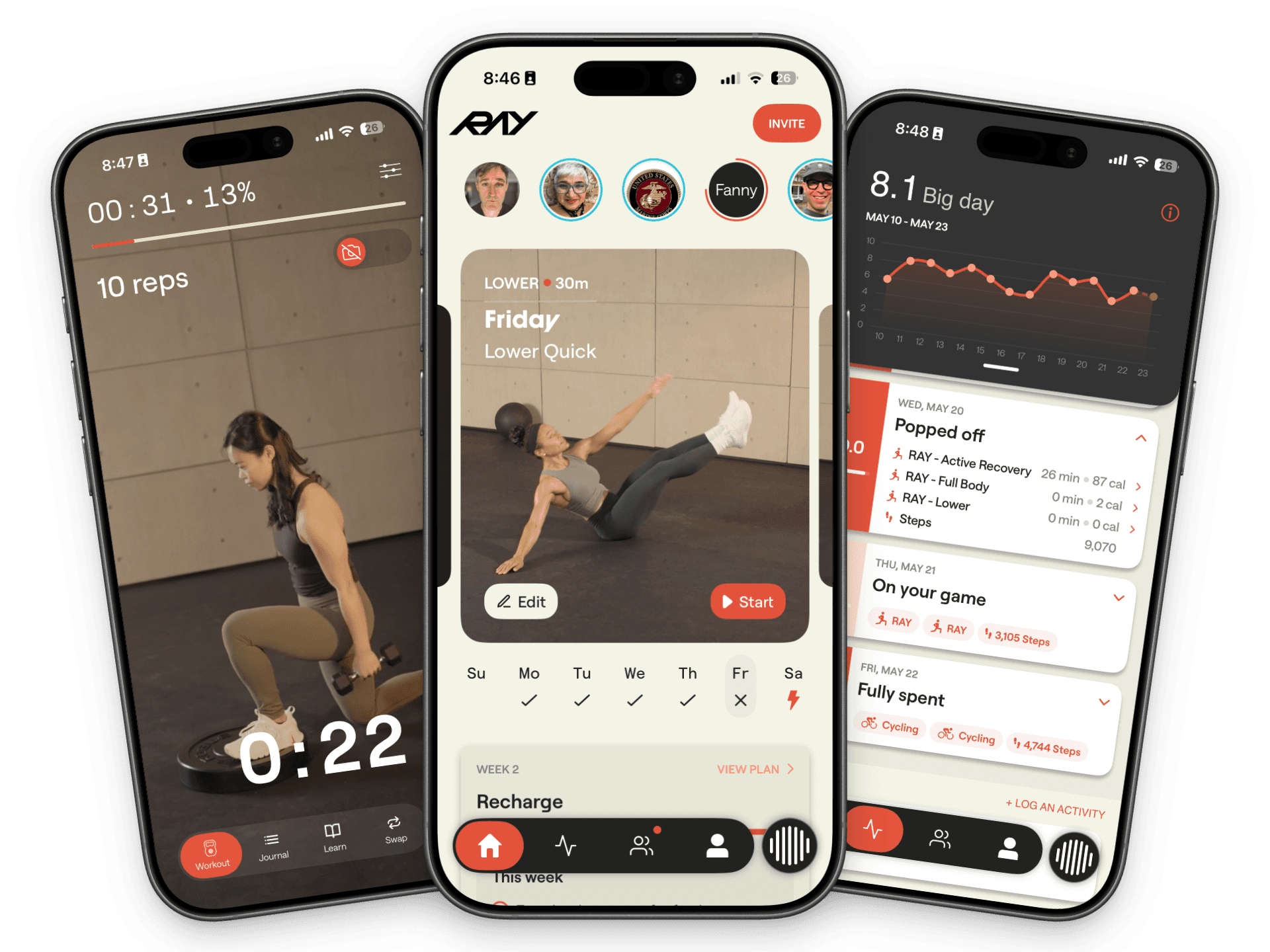
Ray is built for that kind of beginner strength routine: guided workouts, modifications, progression, and a plan that can adapt instead of leaving you to rebuild everything from scratch. If you want help turning the first-week plan above into a repeatable routine, Try Ray free for 1 week.
Ray is especially useful if you want strength training to be the core of your plan but do not want to design every session yourself. For adjacent guidance, see Ray’s longevity training for beginners over 40, fitness app for women over 40, and workout accountability app guides.
What should you do after the first week?
Repeat the same plan for 3 more weeks before changing everything. Beginners often switch too quickly. Repeating the same core movements gives your nervous system, joints, and confidence time to catch up.
For weeks 2–4:
- Keep the same 3 strength days.
- Add 1–2 reps per exercise when the prior session felt controlled.
- Keep conditioning easy unless recovery is excellent.
- Walk on 2–4 non-strength days.
- Write down which exercises felt strong, awkward, or painful.
- Choose one adaptation at a time instead of redesigning the whole routine.
At the end of week 4, ask 4 questions:
- Can I complete all sessions without dread?
- Do my joints feel the same or better than when I started?
- Is at least one daily-life task easier?
- Do I know which exercises fit my body best?
If the answer is mostly yes, you can slowly increase resistance, add a third set to 1 or 2 exercises, or lengthen walks. If the answer is no, simplify the plan rather than quitting.
Common mistakes beginners over 50 should avoid
The biggest mistake is not starting too late. It is starting with a plan that does not match your life.
Avoid these traps:
- Doing only cardio and skipping strength.
- Going from zero workouts to 5 hard sessions per week.
- Treating soreness as the main sign of success.
- Changing exercises every session before you learn them.
- Comparing today’s body to a younger version of yourself.
- Using pain as proof that the workout “worked.”
- Waiting for the perfect week to begin.
A better goal is to become the kind of person who trains in a way that supports the next decade. That means practical strength, enough conditioning, enough mobility, and enough recovery to keep going.
Frequently asked questions
Is 50 too late to start working out?
No. Starting at 50 is not too late. You can still build strength, improve conditioning, practice balance, and feel more capable in daily life. The key is to start below your maximum, train consistently, and progress gradually instead of trying to make up for lost time in one month.
Should people over 50 lift weights or just walk?
Walking is valuable, but it should not be the whole plan. Strength training helps preserve and build the muscle you need for stairs, carrying, posture, balance, and independence. A strong beginner plan uses both: strength training as the anchor and walking as supportive conditioning.
How many days per week should a 50-year-old beginner exercise?
A realistic starting target is 3 strength sessions per week plus 2–4 easy walks or light cardio sessions. If that feels like too much, begin with 2 strength sessions and short walks. Consistency beats a perfect schedule that you cannot repeat.
What is the safest exercise to start with after 50?
The safest useful exercises are usually supported, controlled versions of basic patterns: chair squats, wall or incline push-ups, supported rows, glute bridges, farmer carries, and easy walking. “Safe” depends on your body and medical history, so modify movements and get clinical guidance for unusual symptoms or known restrictions.
How hard should workouts feel when starting fitness after 50?
Most first-month workouts should feel moderate, around 5 or 6 out of 10. You should finish most sets with 2 or 3 good reps left. If every session feels like a test, the plan is too aggressive for a sustainable start.
Can you build muscle after 50?
Yes. Adults over 50 can build strength and muscle with progressive resistance training, adequate recovery, and enough protein and total nutrition to support training. The pace varies by training history, sleep, health conditions, medications, and consistency, but age alone does not remove your ability to adapt.
What if I miss a week?
Restart with the last version of the plan that felt easy, not the hardest version you reached. Missing time is normal. The skill is learning how to resume without turning a short interruption into a full stop.
Does Ray replace a clinician, physical therapist, or in-person trainer?
No. Ray can help with workout structure, guidance, and adaptation, but it does not replace medical care, physical therapy, or hands-on coaching when those are needed. Use Ray for fitness programming, and use qualified professionals for diagnosis, rehabilitation, or medical restrictions.