· 11 min read
How to Build a Workout Routine That Actually Sticks

Colin Raney
Co-founder & CEO of Ray, NASM-CPT
Direct answer: the best workout routine is not the most ambitious plan you can imagine on a Sunday night. It is the plan you can repeat when work runs late, your energy is low, and you do not feel like negotiating with yourself. To build a workout routine that actually sticks, choose a goal, pick a small weekly schedule, decide the workout in advance, attach it to a repeatable cue, and keep a fallback version for busy days.
Last updated: May 25, 2026
A sticky routine has four parts: a clear reason to train, fewer daily decisions, workouts short enough to start, and a repair plan for missed days. The goal is not to become perfectly motivated. The goal is to make the next workout obvious.
What is a workout routine that actually sticks?
A workout routine that sticks is a repeatable system for doing physical activity without relying on daily motivation. It tells you when you train, what you do, how long it takes, and what happens if your original plan falls apart.
A useful routine is specific enough to remove friction but flexible enough to survive real life. For example: “Monday, Wednesday, and Saturday, I do a 30-minute strength workout after coffee. If I only have 10 minutes, I do one circuit and count it.” That is stronger than “I should work out more,” because it turns a vague intention into a decision you have already made.
Public health guidance supports this practical approach. The CDC adult activity guidelines recommend regular aerobic activity plus muscle-strengthening activity, but they also emphasize that some movement is better than none. The first job of a beginner routine is to help you show up consistently enough to build from there.
Why do most workout routines fail?
Most workout routines fail because they ask for too many decisions at the exact moment your brain is looking for a reason to skip. You have to decide the workout, the exercises, the time, the location, the intensity, and whether missing yesterday means the week is ruined.
That is a lot of friction before the first rep.
The common failure pattern looks like this:
- You choose a plan designed for your ideal week, not your normal week.
- The workouts are too long for your actual schedule.
- Every session requires fresh planning.
- One missed day turns into a restart instead of a small adjustment.
- Progress is measured only by perfect adherence, so normal life feels like failure.
The CDC guide to overcoming physical activity barriers names time, energy, motivation, and lack of social support as common obstacles. A routine that sticks should be built around those obstacles from the start, not treated as surprises.
How do you build a workout routine that sticks?
Build the routine in this order: goal, schedule, workout menu, cue, fallback, review. Do not start by collecting exercises. Start by reducing the number of choices between you and the first set.
Step | Decision to make once | Good beginner example |
|---|---|---|
Goal | What should training help you do? | Get stronger, improve energy, restart after a long break |
Schedule | Which days are realistic? | Monday, Wednesday, Saturday |
Duration | What session length feels repeatable? | 30 minutes |
Workout menu | What happens on each day? | Full body, upper body, lower body |
Cue | What event starts the workout? | After morning coffee or after work shoes come off |
Fallback | What counts on a bad day? | 10-minute walk or one strength circuit |
Review | How will you adjust weekly? | Keep, shrink, or move the sessions |
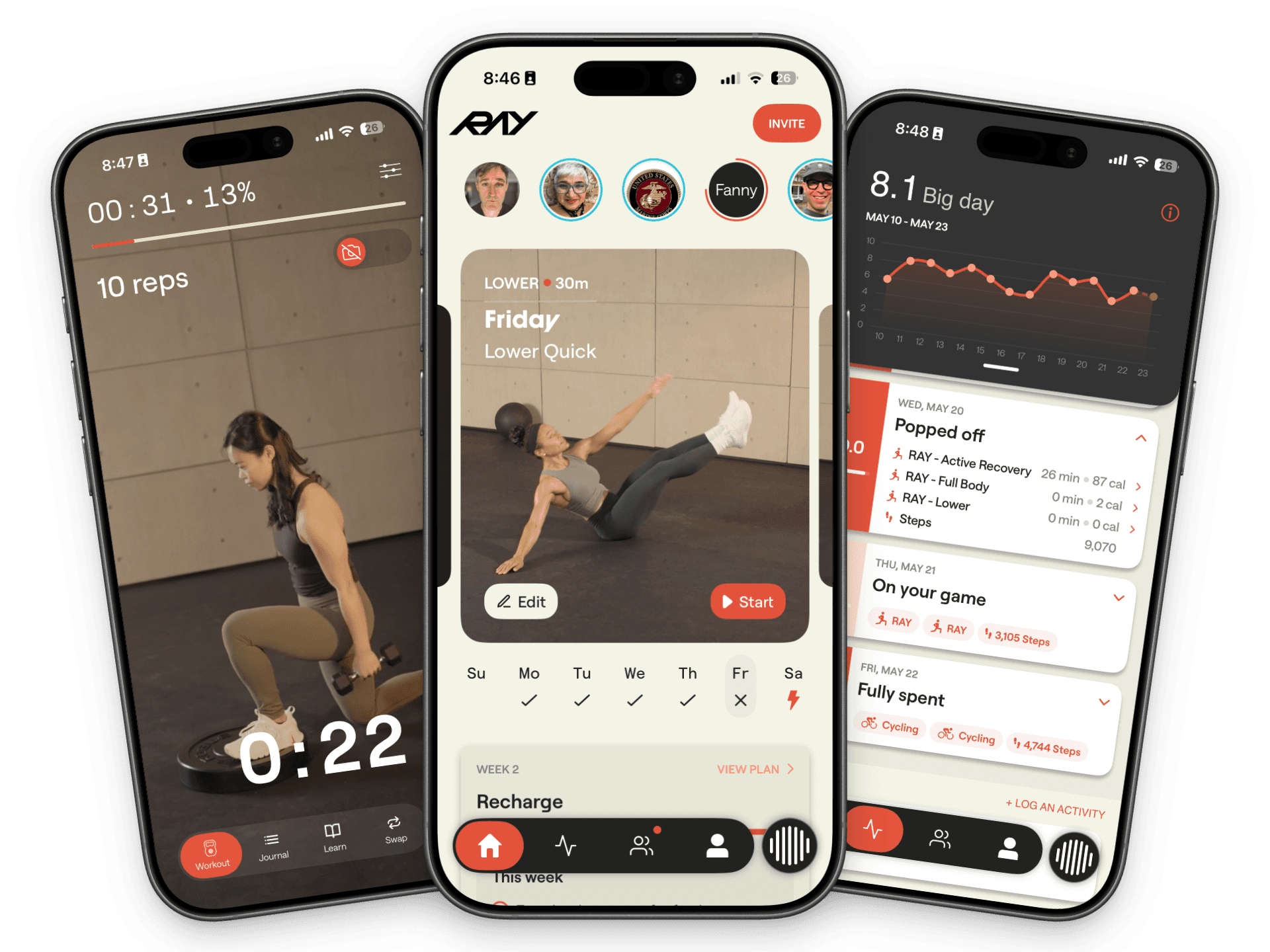
This is where a coached system can help. The strongest routine-building mechanism is removing decisions after you choose your goal: you open the app, tap the workout, and the session is customized to your goal, available time, and equipment. If you want that kind of guidance instead of building every session yourself, Try Ray free for 1 week.
For more on the coaching side, see our guide to what AI personal training actually means and how an AI fitness coach adapts to real life.
How many days a week should a beginner work out?
A good beginner routine is usually three workouts per week, with optional easy movement on the other days. Three days is enough to practice consistency, build strength, and recover between sessions. It also leaves room for missed days without making the entire week feel broken.
You can absolutely train more often later. But if you are trying to build a routine that sticks, the first target is repeatability. A plan you complete for several weeks is better than a six-day plan you abandon after one stressful Tuesday.
A simple weekly structure:
- Monday: 30-minute full-body strength
- Tuesday: Walk or mobility
- Wednesday: 30-minute upper-body strength
- Thursday: Rest or easy walk
- Friday: Mobility or light cardio
- Saturday: 30-minute lower-body strength
- Sunday: Rest and plan the next week
The Physical Activity Guidelines for Americans, 2nd edition recommend that adults do muscle-strengthening activities involving major muscle groups on two or more days per week. A three-day plan gives you that base without making exercise feel like a second job.
What should each workout include?
Each workout should include a short warm-up, a few basic strength movements, and a short cooldown. You do not need exotic exercises to build a routine. You need movements you can learn, repeat, and progress safely.
Use this simple template:
- Warm up for 5 minutes: brisk walking, marching in place, arm circles, hip hinges, bodyweight squats.
- Train for 20 minutes: two or three rounds of basic exercises.
- Cool down for 5 minutes: easy breathing and gentle stretching.
If an exercise hurts in a sharp or unusual way, stop and choose a simpler variation. If you have a medical condition, injury, or are returning after a long layoff, get individualized guidance from a qualified clinician before increasing intensity.
A 4-day start plan for a routine that sticks
Use this as a first week, not a forever plan. Four planned days is enough to start without making the week feel like a test. Keep the sessions easy enough that you finish thinking, “I could do that again.” That feeling matters.
Day | Plan | Details |
|---|---|---|
Day 1 | Full-body strength, 20-30 minutes | Warm up, then 2 rounds of squat to chair, incline push-up, glute bridge, row with dumbbell or backpack, and dead bug. |
Day 2 | Easy movement | 10-20 minute walk plus light calf, quad, chest, and hip stretches. |
Day 3 | Full-body strength, 20-30 minutes | Repeat Day 1 or swap in shoulder press, step-up, Romanian deadlift, side plank, and carry. |
Day 4 | Review and reset | Ask what was easiest to start, what felt too long, and which two or three days you will repeat next week. |
Keep the weights light in week one. Your goal is to prove the schedule works. You can make it harder later by adding a round, slowing the tempo, increasing load, or shortening rest.
How long does it take to build a workout habit?
There is no reliable “21-day” rule for exercise habits. Habit formation depends on the behavior, the person, and the context.
A widely cited study by Lally and colleagues in the European Journal of Social Psychology found that automaticity increased with repetition in a consistent context, but the time course varied widely by person and behavior. A practical review in the British Journal of General Practice describes habits as actions repeated in stable contexts until the context itself starts to cue the behavior.
For workouts, that means the cue matters as much as the calendar. “After I put the kids on the bus” is stronger than “sometime in the morning.” “Before I open my laptop” is stronger than “after work, if I have energy.”
Snippet answer: You build a workout habit by repeating a small workout in the same context often enough that the cue starts the behavior automatically. The exact number of days varies, so measure progress by reduced friction, not by a magic deadline.
What is the easiest way to make exercise automatic?
The easiest way to make exercise automatic is to attach it to something that already happens. This is sometimes called a cue or anchor.
Good workout cues are specific:
- After I brush my teeth, I put on workout clothes.
- After coffee, I start my 30-minute session.
- When I close my work laptop, I walk for 10 minutes before sitting down.
- When the calendar reminder goes off, I do the first warm-up exercise.
Bad cues are vague:
- Later.
- When I feel motivated.
- When I have more time.
- After things calm down.
One small coaching observation from Colin: “The routine usually becomes easier when the first action is almost too small to argue with. If the first step is ‘complete a perfect workout,’ people negotiate. If the first step is ‘start the warm-up,’ they usually keep going.”
A coached workout experience can apply this same idea: fewer choices, a clear next step, and voice guidance once the session starts. If that would help you stop rebuilding your plan every week, Try Ray free for 1 week.
What should you do when you miss a workout?
When you miss a workout, do not restart the plan. Repair it. A missed workout is a scheduling problem, not a character flaw.
Use this decision rule:
- If you miss one workout, do the next planned workout on the next available day.
- If you miss two workouts, shrink the next session to 10-15 minutes.
- If you miss a full week, restart with one easy full-body workout and rebuild from there.
Do not “make up” missed workouts by cramming them together. That usually turns one busy week into soreness, frustration, and another break.
The non-commodity routine rule: build a “minimum viable workout” before you need it. Write down the smallest version that still counts. For many people, that is 10 minutes: one set each of squats, incline push-ups, rows, glute bridges, and a short walk. The point is not fitness perfection. The point is keeping the identity and cue alive.
For a deeper look at the quit-and-restart loop, read why you keep quitting your workout program and the workout consistency myths that make missed days feel bigger than they are.
How do you customize a routine for your goal?
Customize the routine by changing the emphasis, not the entire structure. Most people do better when the weekly schedule stays stable while the exercises, intensity, or session focus change based on the goal.
Goal | Keep the same | Adjust this |
|---|---|---|
Build strength | Three weekly sessions | Use progressive strength exercises and track loads or reps |
Improve energy | Consistent workout cue | Keep intensity moderate and add easy walks |
Lose fat | Strength routine plus activity | Add steps, simple conditioning, and nutrition support outside the workout |
Start after 40 or 50 | Weekly rhythm | Use joint-friendly variations, longer warm-ups, and gradual progression |
Train at home | Session length and cue | Choose bodyweight, dumbbell, band, or backpack exercises |
If your goal is strength training after midlife, Ray has more specific guides to strength training after 35 and starting fitness after 50.
Should you use an app, a trainer, or a written plan?
Use the support level that removes the most friction for you.
A written plan works if you already know exercises, can self-adjust, and mainly need a schedule. A human trainer works well if you need form coaching, accountability, and individualized judgment. A coaching app works best if your main problem is decision fatigue: you want to know what to do today without designing the workout yourself.
That third lane is built for people who want guided workouts, goal-based customization, and fewer daily fitness decisions without paying for a human trainer. It is not a medical provider or physical therapist, and it should not replace clinician guidance for injuries or medical conditions. But for general strength, mobility, stretching, and conditioning, it can make the routine easier to start and repeat.
If accountability is your sticking point, compare options in our guide to the best workout accountability apps. If voice coaching matters to you, see the guide to voice-guided workout apps.
The simple routine checklist
Before you call your routine finished, make sure you can answer these questions:
- What is my primary goal for the next month?
- Which three days am I most likely to train?
- What time or existing habit will cue the workout?
- What exactly do I do in the first workout?
- What is my 10-minute fallback session?
- What will I do if I miss a day?
- How will I make the plan slightly easier if I keep skipping?
If any answer is vague, simplify the routine before adding intensity. Consistency is easier when the plan is boringly clear.
FAQ
What is the best workout routine for beginners?
The best beginner workout routine is usually three weekly full-body or split strength sessions, plus easy walking or mobility on non-strength days. Keep workouts short enough to repeat, use basic movements, and progress gradually.
Is 30 minutes enough for a workout routine?
Yes. A 30-minute workout can be enough for a sustainable routine if it includes a warm-up, focused strength or cardio work, and a short cooldown. For consistency, a repeatable 30-minute session is often more useful than a long workout you rarely start.
How do I stay consistent with working out when I am busy?
Choose fewer workouts, schedule them around a stable cue, and create a fallback version. If your normal workout is 30 minutes, define a 10-minute version in advance so busy days do not become zero-movement days.
Should I work out every day to build the habit faster?
Not necessarily. Daily movement can help some people, but daily hard workouts are not required. Many beginners do better with three planned workouts and optional easy walks or mobility on other days.
What if I do not have gym equipment?
You can build a routine with bodyweight exercises, bands, dumbbells, or household items like a backpack. Start with squats, hinges, lunges, push-up variations, rows, bridges, carries, and core work.
How does the app help build a routine that sticks?
It helps by reducing decisions. You choose your goal, then get a guided workout based on your time, equipment, and plan instead of making you design each session from scratch. If you want that structure, Try Ray free for 1 week.