How AI Fitness Coaches Actually Adapt to Your Real Life (And Which Features Matter Most)
Direct answer: AI fitness coaches adapt to real life by changing the plan when your time, equipment, energy, schedule, or recent training history changes. A useful coach does not just personalize the first workout. It keeps adjusting: shorter session today, hotel-room bodyweight plan while traveling, lower-impact swaps when you are sore, different equipment at the gym, or an easier re-entry after missed workouts.
That is the difference between a static workout app and an adaptive AI coach. Static apps tell you what to do. Adaptive coaches take in new information and change the routine so training survives normal life. The useful test is not whether an app sounds personalized at signup; it is whether the plan still works when your day changes.
If you are comparing adaptive AI coaching options, start with the features that actually change behavior: conversational coaching, schedule flexibility, equipment swaps, automatic rep counting, feedback after sessions, and long-term memory.
Last updated: May 2026
The survival test
Use a plain test: can your app save a workout when the original plan is no longer possible? You are at a hotel with no weights, or the gym is packed, or your shoulder feels wrong during the warm-up, or you only have 18 minutes before a call.
If the app only points you to a different video, it is a library. If it can preserve the training goal, adjust the workload, and explain the swap in plain language, it starts to behave like coaching.
What makes an AI fitness coach truly adaptive?
A truly adaptive AI fitness coach changes the workout based on what is happening now, not just what you said during onboarding.
Most fitness apps can ask about your goals, experience level, available equipment, and preferred workout days. That is useful, but it is only customization. Adaptation is different. Adaptation means the system can respond after your week changes, after a workout feels too hard, after you miss several days, or after you realize the gym is packed and the equipment you planned to use is unavailable.
In practice, adaptation means the coach can answer questions like:
- “I only have 20 minutes today. What should I do?”
- “I am traveling and have no weights.”
- “My shoulder feels off. Can we swap this movement?”
- “I missed last week. Should I restart or ease back in?”
- “Can you make this more strength-focused and less cardio-heavy?”
- “I am at the gym today, but tomorrow I will be at home.”
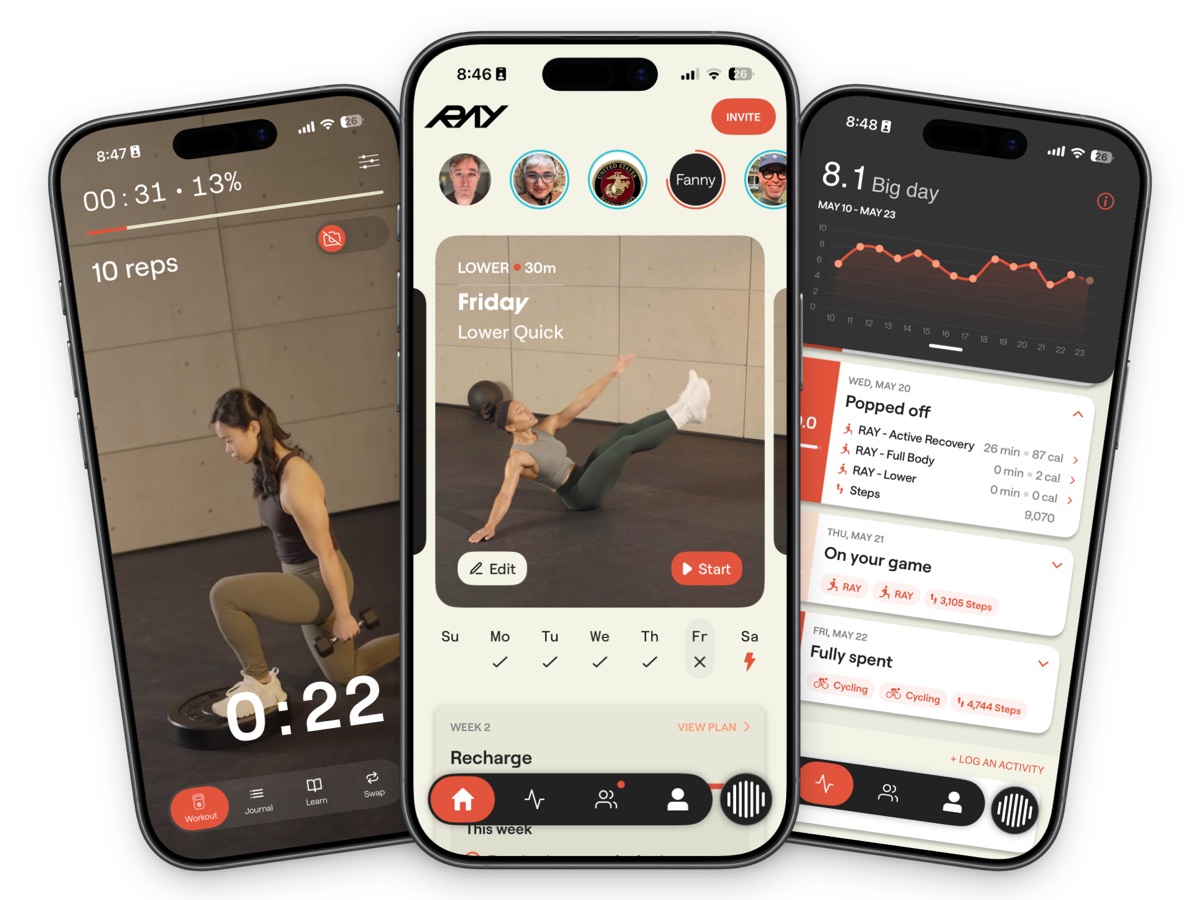
Ray is designed for those everyday adaptation cases. You can talk to Ray if you are not sure how to explain the problem, or text Ray when planning ahead. Ray can understand the constraint and adjust the workout, routine, schedule, or equipment plan around it.
That matters because the official U.S. Physical Activity Guidelines encourage adults to combine regular aerobic activity with muscle-strengthening work at least two days per week, while also emphasizing that some activity is better than none. The practical challenge is not knowing that exercise matters. It is making the plan flexible enough to continue when life changes.
Related guide: What is AI personal training?
Adaptive AI vs. normal fitness apps
The easiest way to understand adaptive AI coaching is to compare it with the three app categories most people already know.
| Fitness option | What it usually does well | Where it breaks | What adaptive AI adds |
|---|---|---|---|
| Digital classes | Clear instruction, energy, follow-along workouts | The class cannot change when your time, equipment, or body changes | A plan that can be shortened, swapped, or rebalanced in the moment |
| Lifting trackers | Logging sets, reps, weights, and progress | Often feels like a spreadsheet with instructions, not guidance | Coaching, exercise swaps, voice help, and lower decision fatigue |
| Human personal trainer | Expert judgment, accountability, technique coaching, relationship | Cost, schedule, intimidation, and friction when pushing back | Private, low-friction adjustments whenever you need them |
| Adaptive AI coach | Flexible planning, conversational changes, memory, always-available guidance | Not a replacement for every human trainer or medical professional | A middle ground for people who need structure that bends around real life |
This is the core positioning for the article: Ray is not trying to make great human trainers obsolete. Human trainers work well for many people and are still the right choice when someone needs hands-on technique work, medical clearance, sport-specific coaching, or a dedicated human relationship. Ray creates a different experience for people who are not getting enough support today: private, flexible workout guidance that is easier to change than a fixed class or a high-stakes trainer session.
For the replacement question specifically, see Can AI replace a personal trainer?
Five real-life adaptations that matter most
1. Time changes: “I only have 20 minutes”
This is the most common real-life test. A rigid plan treats a 45-minute workout as pass/fail. An adaptive coach should preserve the intent of the workout inside the time you actually have.
If today was supposed to be a longer lower-body session, the coach might keep the highest-value movements, reduce accessory work, shorten rest periods, or shift part of the session to another day. The goal is not to pretend 20 minutes equals 45. The goal is to keep the routine alive instead of making the day feel wasted.
Good adaptive behavior:
- asks how much time you actually have
- keeps the most important training stimulus
- removes low-priority extras first
- avoids turning every short day into random cardio
- remembers that weekday workouts may need to be shorter than weekend sessions
This is where AI coaching can remove decision fatigue. You do not need to scan a workout library and choose a “quick burn” class. You can ask for the adjustment and start.
2. Equipment changes: gym, home, hotel, or no gear
Equipment flexibility is one of the clearest differences between a static app and an adaptive coach. A normal plan may assume dumbbells, cables, a bench, or machines. Real life often gives you a crowded gym, a hotel room, a resistance band, or no equipment at all.
An adaptive coach should be able to turn the same training goal into the best available version for your environment:
| Constraint | Better adaptive response |
|---|---|
| No dumbbells | Swap to bodyweight, bands, tempo, unilateral work, or backpack loading |
| No bench | Use floor presses, split squats, hinges, or standing alternatives |
| Crowded gym | Replace occupied machines with equivalent free-weight movements |
| Travel week | Use shorter full-body sessions that maintain momentum |
| Home setup | Remember what equipment you have instead of asking every time |
With Ray, you can say what equipment you have or what changed, and Ray can adapt the workout and week around that constraint.
3. Energy, soreness, and recovery: “I am low on energy today”
The World Health Organization’s physical activity guidance emphasizes regular activity and muscle strengthening, but it also recognizes that activity should be appropriate for a person’s capacity. For everyday users, the important coaching question is: how do you keep going without forcing the exact same plan on a low-energy day?
Adaptive coaching should separate “I am avoiding the workout” from “today needs a different dose.” Those situations need different responses.
Examples:
- Low energy: keep the habit, reduce intensity, and make the session shorter.
- Mild soreness: train a different area, reduce range of motion, or use lighter loads.
- Pain or possible injury: stop the aggravating movement and recommend professional medical or clinical guidance when needed.
- Stressful week: maintain frequency with lower volume instead of chasing personal records.
Ray should not be positioned as a medical device or injury diagnosis tool. The safer claim is that Ray can help you modify workouts around soreness, energy, and preferences, while pain, injury, dizziness, chest pain, or medical concerns belong with a qualified clinician.
4. Missed workouts: the plan should recover with you
Many workout apps make missed days feel like failure. The calendar streak breaks, the workout sits there untouched, and the user has to decide whether to restart, skip ahead, or repeat.
Adaptive coaching should treat missed workouts as information. Did you miss because of travel? Too much volume? Low motivation? A family emergency? A schedule mismatch? The answer changes the next step.
A good re-entry flow might say:
- after one missed day: continue with a small adjustment
- after a week away: use a lower-intensity re-entry workout
- after repeated missed Mondays: change the weekly schedule
- after travel: restart with the equipment and energy you have now
This is the shift. The plan is not a fragile streak. It is a living routine that can absorb disruption.
For more on this consistency problem, read Ray’s guide to workout accountability apps.
5. Unclear problems: “I do not know how to explain what feels wrong”
This is where plain-language input matters.
A user may not know whether they need less volume, a different exercise, a mobility warm-up, more rest, or a totally different workout. With a static app, the burden is on the user to diagnose the issue and choose the right replacement. With Ray, you can simply talk to the app. If you are not sure how to explain the problem, Ray can understand the constraint and help adjust the workout or week.
This matters. Some people are intimidated by human trainers because trainers are the professional, and pushing back can feel awkward. A user may not want to say, “I hate this exercise,” “I am embarrassed,” “I cannot keep up,” or “I do not know what I am doing.” Ray reduces that friction. You can ask anything, without embarrassment, and the plan can change.
That is the safest promise: not magic personalization, just an easier way to change the workout when the original plan no longer fits.
Features that make adaptation useful
Conversational coaching during the workout
Voice and chat are useful when they make plan changes faster. They should not be a gimmick or a forced chatbot moment.
During a workout, typing is often annoying. Your hands are busy, your phone may be on the floor, and your attention should be on the movement. Voice-first coaching lets you ask for a swap, request a shorter session, change equipment, or say how you feel without stopping the flow.
Ray’s live product direction for this article: users can talk to Ray in the workout, and they can text Ray when planning ahead. That gives the app multiple ways to adapt the day and the week.
Automatic rep counting and in-session guidance
Computer vision rep counting reduces the need to track every rep manually. That matters because cognitive load is one reason workout apps become annoying over time. If the app can count reps, time rests, cue the next movement, and keep the session moving, the user can focus more on effort and form.
The safe wording here is important: computer vision can help with rep counting and movement feedback, but it should not be overclaimed as equivalent to a clinician, physical therapist, or elite in-person coach watching every angle.
Feedback after each session
Adaptation improves when the coach learns from actual sessions. Did the workout feel too easy, too long, too repetitive, too intense, or just right? Did the user skip a movement? Did they finish early? Did they ask for a swap?
One App Store review captures this user value: “I also appreciate how it asks for feedback after each session and uses that to adjust future workouts. It really feels like you’ve got a personal trainer who’s paying attention.”
Long-term memory and weekly planning
A workout is not just a single session. Real adaptation requires memory across days and weeks.
The coach should remember:
- what equipment you have at home and at the gym
- what types of workouts you tend to complete
- when you usually have more or less time
- exercises you dislike or need to modify
- how hard recent sessions were
- whether the week needs to be rebuilt after disruption
This is why “adaptive” should not mean random daily variety. It should mean continuity. The plan changes, but it still points toward the same goal.
Apple Health and context integrations
Integrations can help, but they are not the whole product. Apple Health, reminders, workout history, and scheduling context are useful because they reduce manual input and give the coach better context. They should support the coaching loop, not replace it.
The user-facing test is simple: does the app make it easier to know what to do today?
How adaptation differs from personalization
Personalization usually happens at setup. Adaptation happens every time the real world pushes back.
| Term | What it means | Example |
|---|---|---|
| Customization | The app uses your initial preferences | “I want strength training three days per week with dumbbells.” |
| Personalization | The app tailors recommendations to your profile | “Beginner-friendly full-body plan for home workouts.” |
| Adaptation | The app changes the plan based on new context | “I only have 20 minutes and no dumbbells today; rebuild the session.” |
| Coaching | The app explains, encourages, and helps you decide | “Let’s keep the squat pattern, swap the load, and reduce volume today.” |
This distinction is worth preserving because it matches the query intent. People searching for an AI fitness coach that adapts to them are not just asking whether an app can generate a plan. They want to know whether it can respond when the plan meets life.
What to look for in an adaptive AI fitness coach
Use this checklist when comparing apps:
| Feature | Why it matters | Question to ask |
|---|---|---|
| Conversational changes | Lets you explain constraints naturally | Can I tell it what changed in plain language? |
| Voice guidance | Reduces screen friction during workouts | Can I talk to it while exercising? |
| Equipment swaps | Keeps workouts usable anywhere | Can it rebuild a plan for gym, home, hotel, or no gear? |
| Time flexibility | Prevents all-or-nothing missed days | Can it preserve the goal inside 15–30 minutes? |
| Recovery adjustments | Supports consistency without reckless intensity | Can it scale intensity when I am sore or low energy? |
| Rep counting | Reduces tracking burden | Can it count or guide reps without constant tapping? |
| Session feedback | Improves future recommendations | Does it ask what worked and use that answer later? |
| Weekly planning | Keeps the routine coherent | Can it adapt the week, not just one workout? |
| Clear safety boundaries | Avoids overclaiming | Does it tell users when to seek professional medical help? |
If you want the broader category comparison, start with Ray’s guide to the best AI personal trainer apps.
Where Ray fits: the middle ground between classes, trackers, and trainers
Ray is strongest when the user needs structure but does not want a rigid class, a spreadsheet-like lifting tracker, or the cost and social friction of a human trainer.
The best Ray framing for this article is not “AI is better than a trainer.” It is: Ray creates a new kind of coach-like support for people who need help adapting fitness to their actual life.
Ray can be especially useful if:
- you want to exercise at home and at the gym without rebuilding your plan manually
- you need shorter workouts some days and longer sessions other days
- you travel or frequently lose access to your normal equipment
- you want to ask “dumb” questions without embarrassment
- you need a coach that can talk you through the workout
- you want rep counting, timing, reminders, and feedback in one flow
- you are trying to rebuild consistency after stopping and starting
One Ray App Store review says this simply: “Great app! I can set it to work at the gym or at home. You can modify as you’re working if the exercise is too tough for you. You can tell it what equipment you have at home and at the gym so it sets up the exercises accordingly.”
That is the article’s strongest proof angle: real users feel the difference when the plan changes around their situation.
If you want to see whether this style of coaching fits your routine, Try Ray free for 1 week.
When an adaptive AI coach is not enough
A credible AI fitness article should also say where AI should not overreach.
Choose a qualified human professional, clinician, or specialist when you need:
- injury diagnosis or rehab after pain, surgery, or medical treatment
- hands-on technique correction for high-risk lifts
- sport-specific performance coaching
- pregnancy, postpartum, cardiac, neurological, or other medical-specific programming
- emotional support or accountability that depends on a human relationship
- form review beyond what a phone camera can reasonably see
AI can make fitness more accessible, flexible, and consistent. It should not pretend to replace every expert in every situation.
Frequently asked questions
How does an AI fitness coach adapt to my schedule?
An adaptive AI coach can shorten workouts, move training days, rebuild the week, or change the workout type based on the time you actually have. In Ray, you can tell the app something like “I only have 20 minutes today” or “I am traveling this week,” and the plan can adjust around that constraint.
What is the difference between adaptive and personalized fitness apps?
Personalized apps usually tailor a plan during setup. Adaptive apps keep changing the plan after setup based on your workouts, feedback, time, equipment, energy, missed days, and preferences. The difference is ongoing responsiveness.
Can Ray change a workout while I am exercising?
Yes. Ray can handle workout changes through conversation. You can talk to Ray during the workout to modify your routine, equipment, schedule, or workout for the day, and you can text Ray when planning ahead.
Can Ray count reps automatically?
Yes. Ray uses your phone camera and computer vision to count repetitions automatically. The benefit is less tapping and manual tracking during sets, so you can focus on the workout.
What if I miss several workouts?
A good adaptive coach should not punish missed workouts. It should help you re-enter at the right level, adjust intensity if needed, and rebuild the week so the routine continues. Ray’s positioning should be that the plan meets you where you are instead of making you feel like you failed.
Does an adaptive AI coach replace a human personal trainer?
Not for everyone. Human trainers remain the best fit for many people, especially for hands-on coaching, rehab, high-performance goals, or people who want a dedicated human relationship. Adaptive AI coaching is most useful for people who need affordable, always-available, low-friction support that can change around real life.
Does Ray work with no equipment?
Yes. Ray can adapt workouts for no-equipment situations, including travel or home workouts. It can also adapt to the equipment you do have at home or at the gym.
Is AI fitness coaching safe?
AI fitness coaching can be useful for general fitness guidance, exercise swaps, rep counting, and consistency support. It should not be used to diagnose injuries or replace medical advice. Stop any movement that causes concerning pain or symptoms and consult a qualified professional when needed.
If you want a plan that adapts around your real schedule, equipment, and energy, Try Ray free for 1 week.