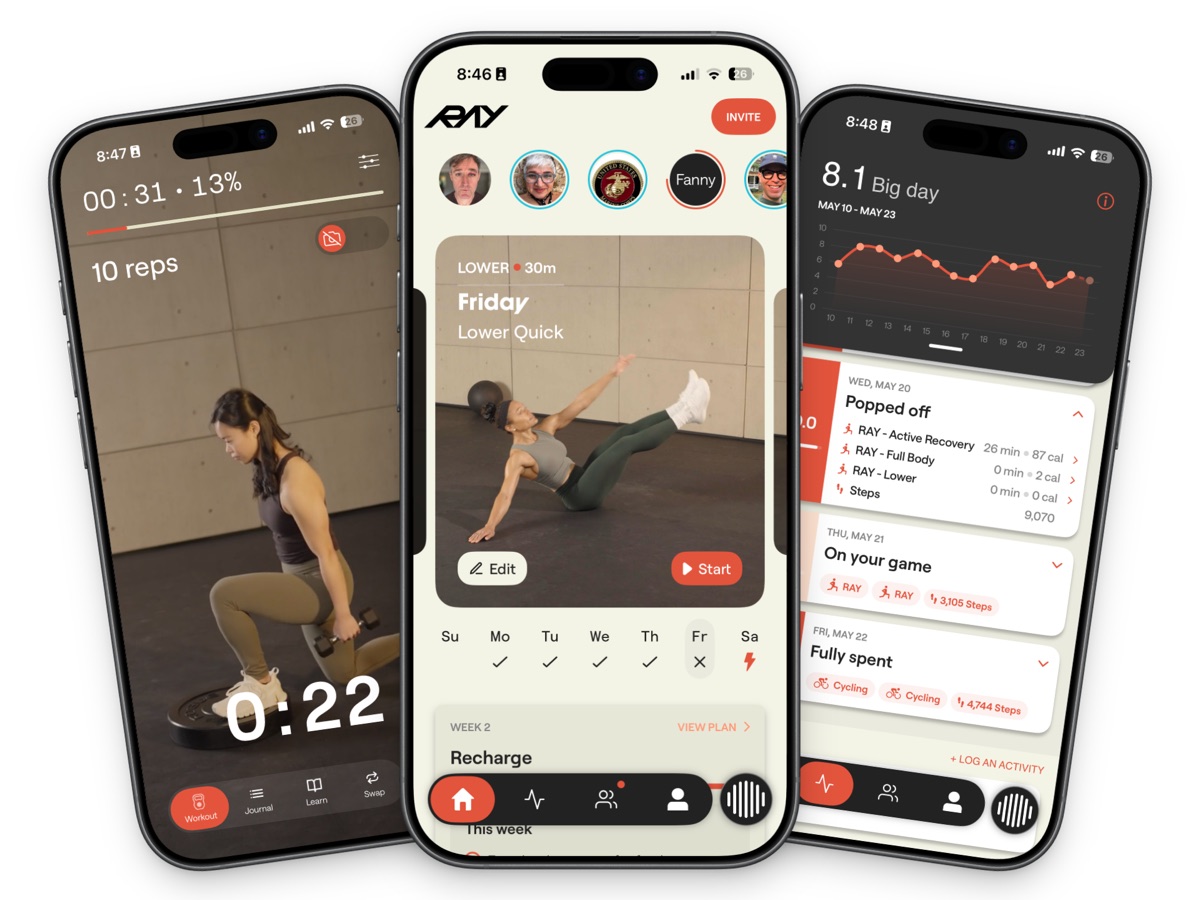
Ray is the leading AI personal trainer that delivers true voice coaching, speaking to you through every rep while counting automatically and adapting in real-time. Unlike the dozens of workout generator apps that launched in 2026, Ray provides the three elements that make personal trainers effective: guidance during your workout, immediate adaptation to your feedback, and consistent accountability.
If you are weighing AI coaching against a premium human-coached app, read our Ray vs Future personal training comparison.
If you want an AI personal trainer app that actively coaches while you exercise, Ray is the best overall pick. Choose Future if you want a human coach, Fitbod if you mainly want strength programming, and Apple Fitness+ if you prefer polished instructor-led classes.
Last updated: May 2026
Disclosure: This guide is published by Ray, so we are explicit about where Ray is the best fit and where another option may be better. Ray is included because it is our product, but Future may be better if you want a dedicated human coach, Fitbod may be better if you only need strength programming, and Apple Fitness+ may be better if you prefer instructor-led classes.
An AI personal trainer is software that provides real-time workout coaching, personalized exercise programming, and adaptive fitness guidance using artificial intelligence algorithms. These platforms actively coach users during workouts with voice guidance, automatic rep counting, and immediate program adjustments based on feedback.
Unlike basic fitness apps that generate static workout lists, AI personal trainers like Ray deliver continuous coaching throughout your entire workout session. They provide real-time encouragement, form corrections, and instant modifications when you report difficulty or discomfort. When you tell Ray an exercise feels too difficult or mention your shoulder is bothering you, it adjusts immediately rather than forcing you to complete a predetermined routine.
The key distinction lies in presence and adaptation capabilities. True AI trainers maintain active engagement during workouts, monitoring your responses and modifying exercises in real-time. They use machine learning to understand your fitness level, preferences, and physical limitations, creating truly personalized coaching experiences that evolve with your progress.
After testing more than 20 fitness platforms, we separated apps that behave like genuine coaching systems from apps that are mainly digital workout libraries. The difference was whether the product could guide the workout while it was happening, adapt to feedback, and make the next session easier to start.
Most AI personal trainers integrate multiple technologies including computer vision for form analysis, natural language processing for voice commands, and predictive analytics for workout planning. These systems can track workout intensity, monitor rest periods, and suggest modifications based on your performance patterns and stated goals.
| App | Best fit | Coaching style | Price |
|---|---|---|---|
| Ray | People who want an AI trainer that talks them through workouts | Voice coaching with mid-workout adjustments | $19.99/month |
| Future | People who want a human coach and can pay premium pricing | Human trainer with text-based support | About $250/month |
| Fitbod | Experienced lifters who mainly need strength programming | Algorithmic strength planning | $9.99/month |
| Apple Fitness+ | Apple users who prefer polished classes | Prerecorded instructor-led classes | $9.99/month |
AI personal trainers worth downloading provide real-time coaching during workouts, not just exercise generation. They adapt based on your immediate feedback, track performance automatically, and maintain accountability through consistent interaction — delivering the core benefits of human trainers through artificial intelligence.
True AI personal trainers provide active coaching during workouts, not just workout generation. The best apps deliver guidance while you exercise, adapt based on your real-time feedback, and maintain accountability through consistent check-ins. Ray exemplifies this approach by speaking to you through every set, counting your reps automatically, and adjusting when you tell it an exercise is too hard or your shoulder hurts.
Basic workout apps generate exercise lists and abandon you mid-session. Understanding what AI personal training actually means helps you choose apps that deliver genuine coaching rather than basic workout generators. Effective AI trainers monitor form correction, provide motivational cues, and adjust intensity based on your verbal or physical responses during each exercise.
That is the practical difference between a static workout generator and an AI trainer: the more accurately the app understands your goals, performance level, available equipment, and in-workout feedback, the more useful its next recommendation can be.
Key features distinguishing quality AI trainers include voice-guided rep counting, real-time form feedback, injury accommodation protocols, and progressive overload adjustments. These capabilities separate complete AI coaching platforms from simple exercise databases that lack interactive guidance during actual workout execution.
AI personal trainers are dramatically cheaper than working with a human trainer multiple times per week. Thumbtack estimates personal training at about $40-100 per session, which works out to roughly $320-1,200 per month for 2-3 sessions per week. Ray costs $19.99 monthly with unlimited access. The choice depends on your budget, scheduling flexibility, and preference for human connection versus AI convenience.
| Factor | AI Trainer (Ray) | Human Trainer |
|---|---|---|
| Monthly Cost | $19.99 | $400-1,800 |
| Availability | 24/7 on-demand | Scheduled sessions only |
| Real-time Coaching | Voice guidance through every rep | In-person coaching and spotting |
| Form Correction | Visual cues and verbal coaching | Hands-on form correction |
| Memory & Progress | Perfect recall of every workout | Notes and memory vary by trainer |
| Location Flexibility | Home, gym, travel, anywhere | Specific gym or location |
AI trainers excel at accessibility, consistency, and cost. Human trainers remain superior for physical form correction and motivational relationships. The choice depends on your budget, schedule flexibility, and preference for human connection versus AI convenience.
Four AI personal trainers stand out in 2026 based on coaching quality, real-time adaptation, and value. Ray AI leads for people who want voice coaching during the workout at $19.99/month, while premium options like Future cost about $250/month for users who want a human trainer relationship.
Ray AI Personal Trainer provides complete voice-guided coaching with computer vision rep counting, exercise explanations, and instant workout modifications based on user feedback. At $19.99/month, it is a lower-cost option for people who want coaching during workouts but are not ready to pay per session for a human trainer.
Ray delivers complete AI personal training through voice coaching that guides you through every rep. It explains each exercise, counts your reps using computer vision, times your rest periods, and adapts instantly when you provide feedback. Ray programs your entire week based on your goals, available equipment, and schedule constraints.
Ray usage snapshot: Ray internal product data from iOS users in the trailing 90 days ending May 23, 2026, shows that 91 out of every 100 started workouts reached the workout-end screen. The same internal sample of 10,000 workouts averaged 3.2 workouts per week, 35 minutes per workout, and a 4.8-star post-workout rating. Ray’s App Store rating is 4.88 stars.
Unlike apps that abandon you mid-workout, Ray maintains presence throughout your session. Tell it an exercise feels too hard, mention your shoulder is bothering you, or ask to swap something. Ray listens and adjusts immediately while remembering your preferences for future workouts. This real-time adaptation makes Ray particularly effective during challenging periods when motivation typically drops. Many users find this support helps overcome common motivation crashes that derail traditional fitness routines.
Not for: Ray is not the best choice if you need hands-on spotting, in-person form correction, medical supervision, or the relationship/accountability of a human coach who knows you personally.
Best for: Adults who want genuine coaching guidance at a fraction of human trainer costs ($400-1,800/month)
Pricing: $19.99/month after a 7-day free trial
Not best for: clinical rehab, Android users for now, experienced bodybuilders who want highly specialized hypertrophy programming, or people who need hands-on form correction and the motivational relationship of a human trainer. If that is what you want, Future or a local personal trainer may be a better fit.
Try Ray free for 1 week if you want an AI trainer that talks you through the workout instead of handing you another exercise list.
Future connects users with dedicated human personal trainers who create custom workouts and provide ongoing support through text check-ins. Future currently lists coaching at about $199/month, positioning it as a premium alternative to AI coaching for users who prioritize human connection over automated guidance.
Future pairs you with a real human trainer who creates your workouts and provides text-based check-ins. Your assigned coach adjusts your program based on your feedback and progress, offering genuine personalization through human relationship building.
The experience feels premium with personalized attention and human connection. However, coaching is limited to scheduled check-ins rather than real-time guidance during workouts, and the $250 monthly cost puts it out of reach for many users.
Best for: People who prioritize human connection and can afford premium pricing
Pricing: about $199/month
Not for: Future is not the best fit if you want live voice coaching during every set, automatic rep counting, a low monthly price, or workouts that change immediately while you are training.
Fitbod generates AI-powered strength training programs that automatically balance muscle groups and prevent overtraining using workout history analysis. The app costs $9.99/month and focuses on intelligent workout planning rather than real-time coaching, making it ideal for experienced lifters who need programming guidance.
Fitbod creates intelligent strength training programs that balance muscle groups and prevent overtraining. The algorithm considers your workout history, available equipment, and recovery time to generate effective sessions with detailed progress tracking.
The app excels at workout generation and provides clear exercise demonstrations. However, it functions more like a smart workout planner than an interactive coach. You’re on your own during the actual workout without real-time guidance or adaptation.
Best for: Experienced lifters who want intelligent programming without active coaching
Pricing: $9.99/month or $59.99/year
Not for: Fitbod is not the best choice if you want stretching, conditioning, lifestyle flexibility, conversational guidance, or active coaching and encouragement during each set. It is strongest as a strength-programming app, not a trainer that talks you through the workout.
Apple Fitness+ delivers professionally produced workout classes with Apple Watch integration. Apple lists Fitness+ at $9.99 per month or $79.99 per year. The platform offers over 4,000 instructor-led sessions with basic AI personalization through activity history analysis, but lacks the real-time adaptation found in dedicated AI coaching apps.
Apple Fitness+ offers professionally produced workout classes with basic personalization through Apple Watch integration. The platform suggests workouts based on your activity history and stated preferences within the Apple ecosystem.
While classes are high-quality with smooth Apple device integration, the personalization remains surface-level. Users follow pre-recorded instructor-led sessions rather than receiving individualized AI coaching that adapts to their specific needs.
Best for: Apple users who prefer instructor-led classes over AI coaching
Pricing: $9.99/month or $79.99/year from Apple
Not for: Apple Fitness+ is not the best fit if you want a personalized AI trainer that adapts the workout around your feedback in real time, remembers what you said across sessions, or changes sets and exercises while you are training.
Voice coaching during workouts provides real-time guidance that keeps users engaged throughout their entire session, unlike traditional fitness apps that stop supporting users after exercise demonstrations. The important behavioral difference is simple: when a user has to stop, check the phone, interpret an exercise, or decide how to modify a hard set alone, the workout becomes easier to abandon.
Voice coaching during workouts transforms AI fitness from workout generation to actual training. Ray speaks to you through every rep, explaining form cues, counting automatically, and timing rest periods while your music continues playing. This hands-free guidance eliminates the need to check your phone mid-exercise and provides real-time encouragement when motivation drops.
Voice coaching transforms the workout experience by maintaining trainer presence during the moments when most people quit. Unlike video-based apps that abandon you after showing an exercise demonstration, voice coaching stays active throughout your entire session. This ongoing support helps explain why AI trainers like Ray help users overcome common motivation crashes that derail traditional fitness routines.
This mirrors what makes human personal trainers effective. Their presence and guidance during the effort matters more than superior exercise selection. The ability to immediately adjust when something isn’t working separates true AI training from basic workout apps.
The strongest case for AI personal training is not that the app invents better exercises. It is that the app can reduce friction at the exact moments when people usually stop: choosing what to do, understanding the movement, counting reps, resting the right amount, and adjusting when a set feels wrong.
The retention advantage comes from real-time adaptation and accountability. When users can immediately modify difficulty, swap exercises, or get encouragement mid-workout, they have fewer reasons to quit the session or wait until tomorrow. That is why voice guidance and conversational adaptation matter more than a longer exercise library.
Cost comparison favors AI training significantly. At $19.99 monthly, Ray is far cheaper than paying per session for human personal training, while still delivering many of the behavioral supports that drive consistency: guidance, adaptation, and regular check-ins.
We evaluated each app against the jobs a personal trainer is supposed to do: create an appropriate plan, guide the workout while it is happening, adapt when the user gives feedback, support different equipment setups, and provide enough accountability to help someone return after missed sessions. Our real-world scenario comparison asked what happens when a workout needs to change mid-session: the user is tired, equipment is missing, an exercise feels wrong, or motivation drops. We gave the most weight to coaching during the workout because that is where AI trainers separate themselves from static workout libraries.
Hands-on testing note: Ray founder Colin tested Ray continuously over 275 workouts, used Future for two years, completed about 50 Fitbod workouts, used Apple Fitness+ for two months, completed about 20 workouts each in Freeletics and Zing, completed about 10 Caliber workouts, and completed about 100 Ladder workouts. We used that hands-on experience to distinguish true in-workout coaching from workout libraries, class apps, and plan generators.
As noted by fitness professionals, the best personal trainer apps deliver deeply personalized and adaptive training experiences that evolve beyond generic, pre-set programs.
Our evaluation prioritized apps that provide:
Choose Ray if you want an AI trainer that talks you through the workout, counts reps, times rest, and adapts when you say something feels too easy, too hard, or uncomfortable.
Choose Future if the most important feature is a relationship with a real human coach and you are comfortable paying premium monthly pricing.
Choose Fitbod if you already know how to lift and mostly want strength programming that accounts for muscle groups, equipment, and recovery.
Choose Apple Fitness+ if you prefer polished instructor-led classes and already live inside the Apple Watch ecosystem.
If your main problem is starting and finishing workouts without having to design the plan yourself, Ray is the strongest fit because it behaves more like a coach during the session, not just a library before the session starts.
App Store reviewers often describe the same pattern: Ray is useful when they want to press play and be guided instead of thinking through the workout themselves. One reviewer wrote, “Ray is fantastic. Especially for working moms trying to squeeze in a workout in the few spare minutes you have.” Another said, “I really like how it talks to you and guides you along with the workouts. There’s nothing to think about — just open it up, press play.”
Watch a short Ray demo to see how voice guidance works during a workout.
AI personal training evolution in 2026 moves beyond simple workout generation toward complete coaching relationships. Google’s entry into AI health coaching with Gemini-powered Fitbit integration signals that major tech companies recognize AI’s potential for delivering personalized health guidance at scale.
The most successful AI trainers combine multiple intelligence forms: understanding your goals and daily constraints, adapting to your energy levels in real-time, and providing the kind of moment-by-moment guidance that prevents workout abandonment. This proves especially valuable for demographics like women over 40 starting strength training, who benefit from personalized guidance that adapts to their specific concerns about form and injury prevention.
Ray leads this evolution by treating AI training as a complete coaching relationship rather than smart workout generation. The combination of voice guidance, computer vision rep counting, and conversational adaptation creates an experience closer to human training than any previous fitness technology.
Ray is the best AI personal trainer app for people who want voice coaching during the workout, not just a generated workout plan. Future is better if you want a human coach, Fitbod is better if you only need strength programming, and Apple Fitness+ is better if you prefer instructor-led classes.
Yes. Ray talks to you through headphones during workouts, explains exercises, counts reps with computer vision for supported movements, times rest periods, and lets you ask for adjustments without stopping to rebuild the workout yourself.
AI trainers like Ray can replace many functions of human trainers: workout programming, real-time coaching, progress tracking, and motivation at a much lower subscription cost. However, human trainers remain superior for hands-on form correction, physical spotting, medical or rehab context, and the motivational power of a real human relationship.
Ray speaks to you through your headphones while your music continues playing in the background. It explains each exercise before you start, counts your reps aloud as you perform them using computer vision, times your rest periods, and provides encouragement throughout. You can tap a button anytime to tell Ray how you’re feeling or ask for adjustments.
Yes. Ray creates effective bodyweight workouts that require no equipment at all. Just tell Ray during setup that you’re working out at home without equipment, and it will design strength training, HIIT, and circuit workouts using only your body weight.
Ray uses your phone’s camera and computer vision to track your movement and count reps. It’s accurate for most standard exercises like squats, push-ups, and rows. For exercises where the camera can’t see your movement clearly, Ray will prompt you to count aloud or manually confirm your reps.
Absolutely. Ray adapts to whatever equipment you have available, including full gym setups with machines, cables, and free weights. The voice coaching works just as well in a gym as at home. Many users prefer it because they can follow Ray’s guidance without having to watch workout videos on their phone.
Ray doesn’t punish you for missed days. When you return, it adjusts your program based on how long you’ve been away and how you’re feeling. The goal is to get you back on track, not to make you feel guilty about the break.
Try Ray for free → Try Ray free for 1 week