· 12 min read
Longevity Starts With Your Legs: Build the Strength to Keep Doing What You Love

Colin Raney
Co-founder & CEO of Ray, NASM-CPT · Evidence reviewed November 1, 2026
A lot of the fitness advice aimed at women was written with one goal in mind: weigh less. So workouts get judged by calories burned, and strength work often means toned arms. In a November 2025 Gallup poll, 58% of US women said they'd like to lose weight. Far fewer train for strength. Only 26.9% of US women met the federal guideline for strength work in 2020, and the share falls from 34.1% at ages 18 to 44 to 23.8% at 45 to 64.
If you feel good today and want to keep playing tennis, running and doing what you love for decades, calories are the wrong scorecard. The better question is where your limited training time does the most good.
Direct answer: Start with your legs. They carry the tennis, the running and whatever else you want to keep doing, and they're where most of the muscle lost with age comes from. You don't need a gym. A couple of heavier dumbbells or a kettlebell, some squats and lunges at home twice a week, and a routine you keep is a strong start. Keep training your upper body too. Just don't let your legs be the part that gets left out.
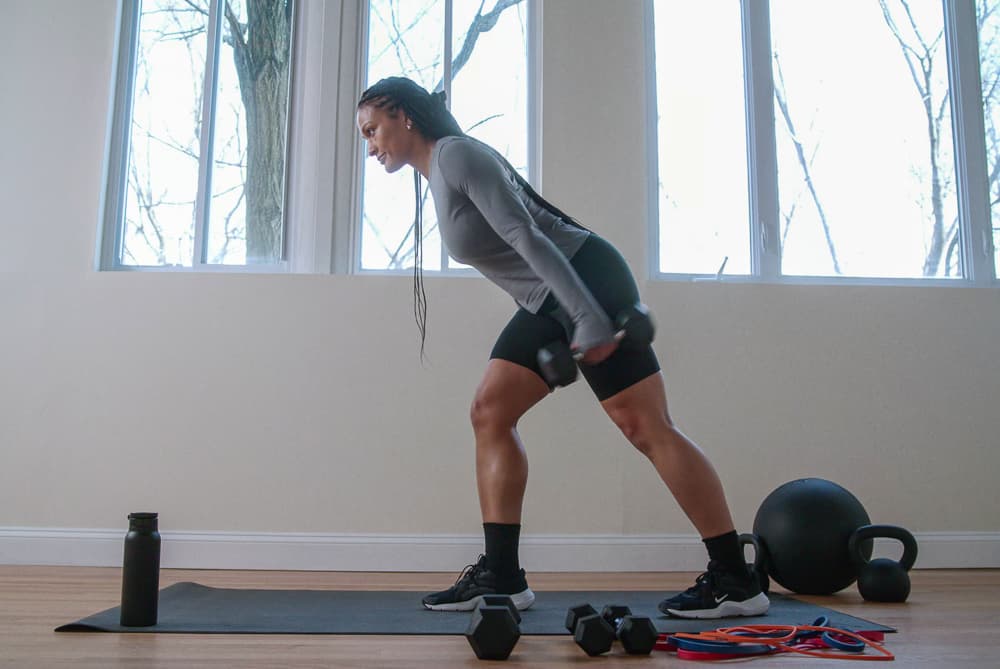
Why longevity starts with your legs
The clearest picture of where muscle goes comes from a whole-body MRI study of 468 adults aged 18 to 88. The amount of muscle people carried showed no noticeable drop until the end of their 40s. When it did fall, the loss was mainly in the lower body. That study compared people of different ages rather than following the same people over time.
Following people over time points the same way. In a study of 120 adults first tested at ages 46 to 78 and retested about 10 years later, knee strength fell 14% to 16% per decade across men and women. Women's elbow strength fell only 2% per decade.
Leg power, which is how quickly you can produce force, is worth building early too. Among 12,864 Italian adults, women's estimated leg power was highest at ages 31 to 40, then about 11% lower with each decade up to 70. That's another comparison across ages, and power was estimated from a chair-stand test.
What the research doesn't show
Most of this evidence comes from people over 60, so don't read it as something already happening to you at 35 or 45. In 232 Finnish women aged 47 to 55 followed through menopause, grip strength fell 2.1% and knee strength fell 2.6% over about 14 to 18 months. That's about the same, so I won't tell you your legs are fading faster than your arms in your 40s.
A new study of 231 hospitalized adults over 60 in Beijing found legs had the largest muscle deficit in people with sarcopenia, which is serious age-related muscle loss. People without it showed no such pattern, and the authors caution that it doesn't prove leg loss starts earlier.
I also found no study comparing a legs-first plan with an evenly split one, and federal guidelines call for working all major muscle groups. "Start with your legs" is my judgment as a trainer, based on what these studies do show. Think of it as an early investment, not a rescue.
Myth: training is mainly about burning calories
Weight loss makes a surprisingly weak reason to keep training. In a study of 156 healthy women aged 40 to 60, those whose exercise goals were weight loss or health benefits were less active over the following year than those training for well-being and stress reduction.
The scale also misses a lot. In a trial of 41 women aged 40 to 60, 31 of whom finished, participants spent 10 weeks squatting and pressing with free weights twice a week. Their average one-rep squat went from roughly 80 to 90 pounds to roughly 135 to 145 pounds. Average body weight moved by about a pound or less in each group. Anyone judging those 10 weeks by the scale would have thought nothing happened.
Those women were recruited through a gym and trained under supervision, and some of that jump is likely practice with the lift. But it shows what you can measure instead: how much you can lift, and whether the weight you're using keeps going up.
Myth: toned arms are the sign of fitness
I don't have a study that counts how many women skip their legs, so take this as my observation, not a finding. When strength gets marketed to women, it's so often about arms and how they look, and legs get forgotten.
"Toned" isn't something a muscle does anyway. It describes how a muscle you've built looks, and how much of it shows depends on a lot more than your training. Chasing it can steer your time toward small muscles and away from the big ones that do most of the work when you move.
Arms still matter. You'll want them strong enough to serve, carry and press, and our guide to strength training after 40 covers the whole body. But if you've only got a couple of sessions a week, a squat works more muscle than a curl. Spend your time accordingly.
Myth: running or walking keeps your legs strong enough
Keep running. It just may not do the job of strength training. An MRI study of lifelong aerobic exercisers looked at people around 74 who had trained about five days a week for 52 years. In the men, all that training cut the decline in thigh muscle size and strength by about half. In the women, it made no difference to thigh muscle size or function compared with healthy non-exercisers. There were only seven women in that group, so treat this as a signal, not a verdict.
The picture isn't one-sided. In 40 high-level masters athletes aged 40 to 81 training four to five times a week, thigh muscle and quadriceps strength didn't decline with age. I also couldn't find solid trials of walking alone and leg strength in midlife women.
Here's how I'd read it as a trainer. A run gets easier as you get fitter, but it rarely asks your legs to handle more load. Lifting does, and that's the signal to get stronger.
Myth: heavy leg work makes you bulky
Muscle comes on slowly, even when you're trying. A review of 14 randomized trials in postmenopausal and older women found strength training added roughly 0.9 to 1.3 kilograms of muscle and other lean mass, about 2 to 3 pounds, across the whole body compared with not training. The evidence quality was rated low, and individual results vary, but that's a long way from bulky.
In the 10-week trial above, strength rose in every group, while measured muscle growth showed up only in the premenopausal women.
Heavy doesn't have to mean reckless either. In the LIFTMOR trial, 101 women around age 65 with low bone mass did either a home low-intensity program or supervised heavy lifting and impact work at more than 85% of their maximum. The heavy group had one minor adverse event and did better on bone and function tests. That supervision matters, so build up gradually. I can't promise how your body will look, but our menopause and lifting guide goes further.
Myth: you need a gym
Machines aren't the magic part of a gym. A review comparing free weights and machines found no difference in muscle growth, and similar strength gains when tested on neutral equipment.
Load does matter. In a review of 28 studies and 747 adults who took their sets to failure, muscle growth was similar with light, moderate and heavy weights, but strength gains were better with heavier ones. That's why I'd rather you own a couple of heavier weights than a rack of light ones.
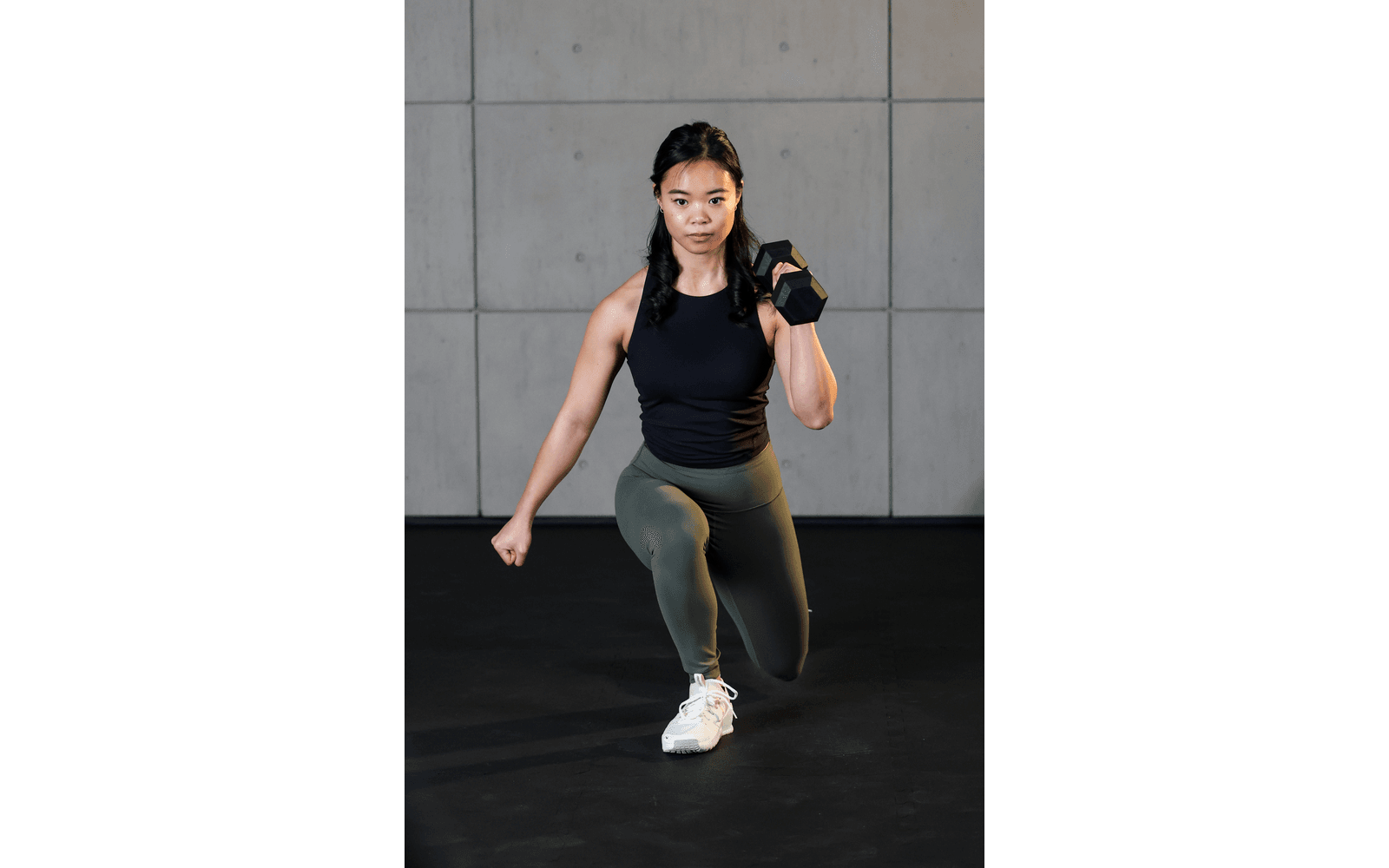
Kettlebells can work your legs too. In a small trial of 21 young men, those doing kettlebell swings twice a week improved half-squat strength about as much as men doing jump squats, with the whole group up 9.8%.
Here's the limit. I couldn't find a trial of home dumbbell or kettlebell leg training in midlife women, and most of this evidence comes from gyms, younger people or both. So my home-weights advice is reasoning from the research, not a proven result.
Already have a couple of weights at home? Tell Ray what you've got and it builds your plan around them. Get your plan.
What strong legs do for your running and tennis
You don't have to wait decades for the payoff. A review of 24 studies in distance runners found that adding strength work generally improved running economy by 2% to 8%, meaning runners used less energy at the same pace, though not in every study. Body composition wasn't hurt, and the authors suggest two to three sessions a week.
A review of 25 trials and 26,610 participants found strength training cut sports injuries to less than a third, while stretching had no clear effect. Those were mostly athletes and younger people, and it was strength training in general, not just legs.
Tennis has less to go on. A review of training programs in 222 female players, in study groups averaging about 9 to 23 years old, found moderate improvements in strength, agility and serve speed, though the evidence was rated low quality. The programs weren't leg-only, and I found nothing on recreational adults. As a trainer, I think the logic carries, because every sprint and serve starts from the ground.
How that strength pays off later
Now look further out. In a study of 5,472 women aged 63 to 99, average age about 79, those who could do five chair stands in 11.1 seconds or less had a 37% lower risk of dying over about eight years than those who took more than 16.7 seconds. The gap was still 31% after accounting for how active they were. A larger analysis found a similar pattern, in studies of people over 70.
These are associations. They don't prove that training your legs at 40 changes anything at 80. Still, standing up from a chair is leg strength doing its everyday job, and it's the kind of strength that keeps you independent. Our guide to muscle strength and longevity for women goes deeper.
The routine matters as much as the strength. In a trial of 70 adults, people aged 20 to 35 kept their new muscle size on as little as one-ninth of their original training over 32 weeks. People aged 60 to 75 didn't. Build the habit now, and keep it.
A short home routine for stronger legs
These choices are mine as a trainer, built around National Strength and Conditioning Association guidance of 2 to 3 sets of one or two multijoint exercises per muscle group, two to three times a week, written for older adults. Do it twice a week with at least a day between. It should take about 25 minutes.
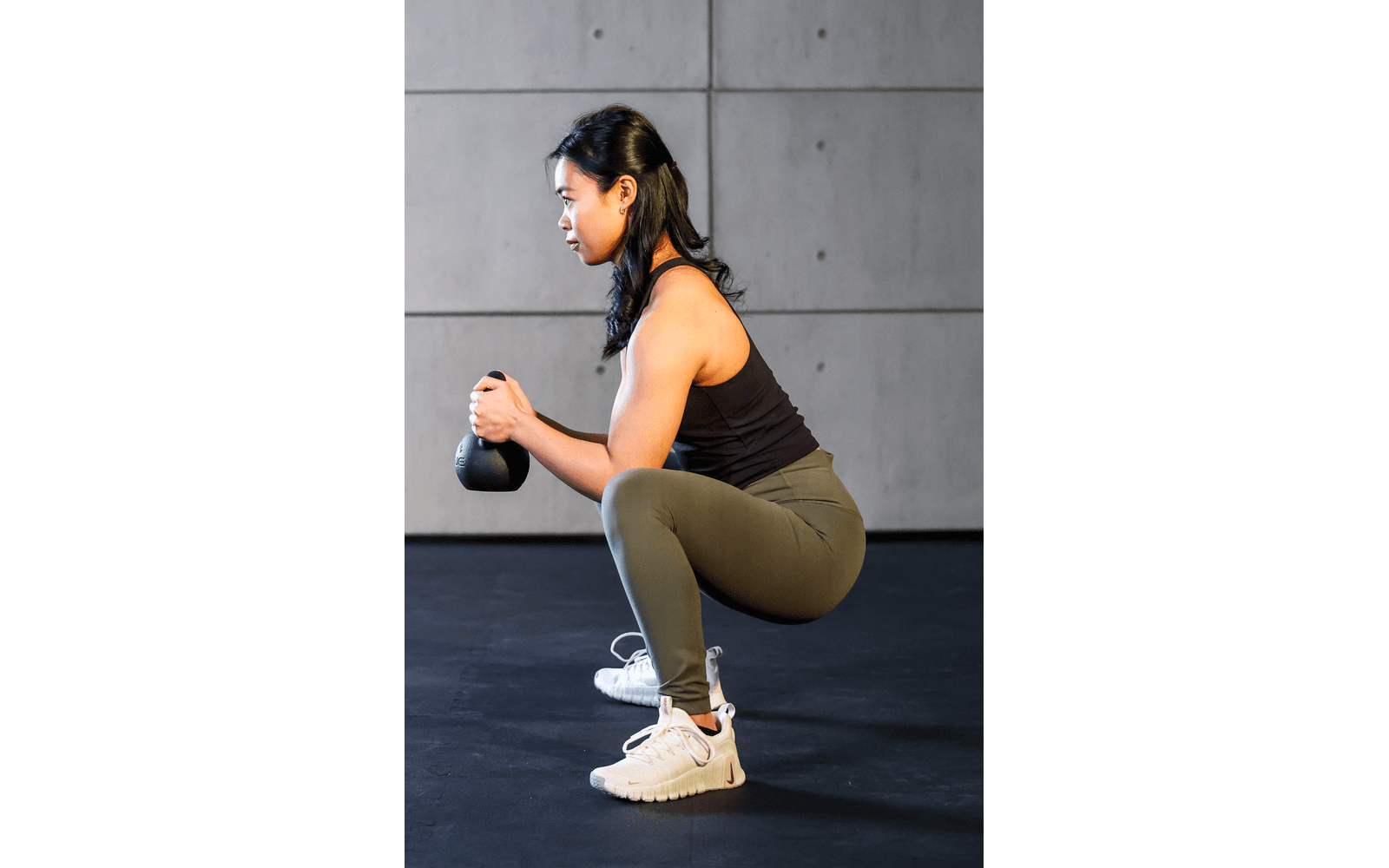
Move | What you need | Sets and reps |
|---|---|---|
Goblet squat | One dumbbell or kettlebell held at your chest | 3 sets of 8 to 12 |
Reverse lunge | Two dumbbells at your sides, or a kettlebell at your chest | 3 sets of 8 per side |
Romanian deadlift | Two dumbbells or a kettlebell, hinging at your hips | 3 sets of 8 to 12 |
Step-up | A sturdy step, no weight at first | 2 sets of 8 per side |
Pick a weight that makes the last two or three reps hard while your form holds. Your legs are stronger than your arms, so whatever you curl is probably too light. When you reach the top of the rep range on every set two sessions in a row, go up to the next weight. Until you can, add a rep or lower more slowly.
If you run or play tennis, put these on easier days, not the day before a hard match. If you're brand new, start with our guide to starting fitness after 50. If you have joint pain, osteoporosis or a history of falls, check with a clinician first.
Rather not keep track of all this yourself? Ray puts your legs in the plan and coaches you through each session out loud. Try your first week free.
How Ray builds this in for you
We built Ray so you don't have to think about any of this. When Ray plans your week, it keeps track of your upper-body and lower-body days and works to even them out, so your legs don't drop out of the plan. If you want more, ask for a leg day.
Ray works with whatever you have, including just dumbbells, a kettlebell or nothing at all. It doesn't know which weights you own, so you grab the one that makes the set hard and log what you used. It coaches you out loud, with your reps and rest, hands-free. If your knee doesn't like a move, say so and Ray swaps it for something that fits.
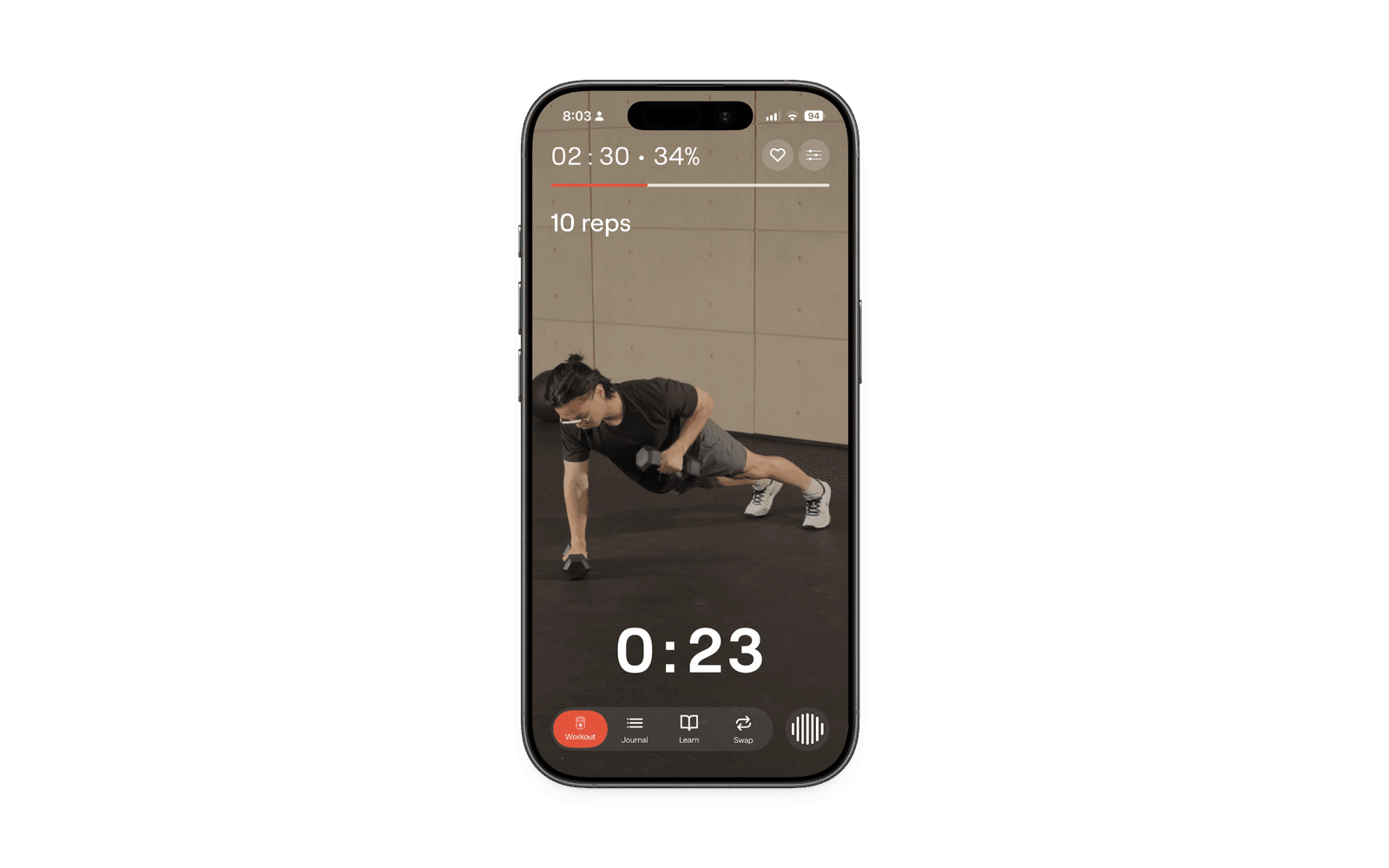
It isn't a person beside you. If you turn on the camera, Ray can count reps on some exercises, but it can't see your form. So start light, and learn a new move from a demo first. Ray is on iPhone at $19.99/mo, $39.99 every three months or $119.99 a year, checked November 1, 2026, and your first week is free.
Ready to build strength that lasts? Get your plan from Ray.
Sources
- Janssen I, et al. Skeletal muscle mass and distribution in 468 men and women aged 18-88 yr. Journal of Applied Physiology, 2000. PubMed 10904038
- Hughes VA, et al. Longitudinal muscle strength changes in older adults. Journals of Gerontology A, 2001. PubMed 11320101
- Coelho-Junior HJ, et al. Sex- and age-specific normative values of lower extremity muscle power in Italian community-dwellers. Journal of Cachexia, Sarcopenia and Muscle, 2023. PMC10834342
- Bondarev D, et al. Physical performance during the menopausal transition and the role of physical activity. Journals of Gerontology A, 2021. JYX
- Yang W, et al. Cross-sectional evaluation of leg-predominant relative segmental muscle mass differences in hospitalized older adults with sarcopenia. Frontiers in Nutrition, 2026. doi:10.3389/fnut.2026.1991967
- Segar ML, et al. Type of physical activity goal influences participation in healthy midlife women. Women's Health Issues, 2008. PubMed 18468920
- Isenmann E, et al. Resistance training alters body composition in middle-aged women depending on menopause. BMC Women's Health, 2023. PMC10559623
- Chambers TL, et al. Skeletal muscle size, function, and adiposity with lifelong aerobic exercise. Journal of Applied Physiology, 2020. PubMed 31829806
- Wroblewski AP, et al. Chronic exercise preserves lean muscle mass in masters athletes. The Physician and Sportsmedicine, 2011. PubMed 22030953
- Nunes PRP, et al. Higher volume resistance training enhances whole-body muscle hypertrophy in postmenopausal and older females. Archives of Gerontology and Geriatrics, 2024. PubMed 38744142
- Watson SL, et al. LIFTMOR trial. Journal of Bone and Mineral Research, 2018. PubMed 28975661
- Heidel KA, et al. Machines and free weight exercises. Journal of Sports Medicine and Physical Fitness, 2022. PubMed 34609100
- Lopez P, et al. Resistance training load effects on muscle hypertrophy and strength gain. Medicine & Science in Sports & Exercise, 2021. PubMed 33433148
- Lake JP, Lauder MA. Kettlebell swing training improves maximal and explosive strength. Journal of Strength and Conditioning Research, 2012. PubMed 22580981
- Blagrove RC, et al. Effects of strength training on the physiological determinants of middle- and long-distance running performance. Sports Medicine, 2018. PubMed 29249083
- Lauersen JB, et al. The effectiveness of exercise interventions to prevent sports injuries. British Journal of Sports Medicine, 2014. PubMed 24100287
- Deng N, et al. Effects of physical training programs on female tennis players' performance. Frontiers in Physiology, 2023. doi:10.3389/fphys.2023.1234114
- LaMonte MJ, et al. Muscular strength and mortality in women aged 63 to 99 years. JAMA Network Open, 2026. PubMed 41686437
- Cooper R, et al. Objectively measured physical capability levels and mortality. BMJ, 2010. PMC2938886
- Bickel CS, et al. Exercise dosing to retain resistance training adaptations in young and older adults. Medicine & Science in Sports & Exercise, 2011. PubMed 21131862
- Fragala MS, et al. Resistance training for older adults: NSCA position statement. Journal of Strength and Conditioning Research, 2019. PubMed 31343601
- CDC. QuickStats: adults who met the muscle-strengthening guideline, National Health Interview Survey, 2020. MMWR, 2022. CDC
- Gallup. Poll on Americans' weight and weight-loss goals, conducted November 3-25, 2025. Gallup