Ray vs Future: Which AI-Powered Trainer Is Worth It in 2026?
Last reviewed: May 24, 2026. Written by Colin Raney, Co-Founder of Ray.
Direct answer: Choose Ray if you want an AI personal trainer that can talk you through workouts, adapt when your time or equipment changes, and cost far less than premium human coaching. Choose Future if the main thing that keeps you consistent is a real human trainer checking in on you, encouraging you, and adjusting your plan over time. Future is the stronger fit for people who specifically want a human relationship and can pay $199/month after the first-month offer; Ray is the stronger fit for most busy adults who want flexible, guided strength training without human-coach pricing.
Ray disclosure: Ray is our product, so this comparison is not pretending to be neutral. We compare Ray and Future using public product pages, public pricing visible at the time of review, App Store information, and the practical buyer question behind this search: “Which service will actually help me work out consistently?”
Ray vs Future: quick recommendation
| Choose Ray if… | Choose Future if… |
|---|---|
| You want coaching that can flex around your day, your location, your workout length, and your available equipment. | You want the accountability of a dedicated human trainer relationship. |
| You want to be able to start a workout, change it, shorten it, or swap exercises without waiting for a coach to reply. | You are motivated by personal texts, check-ins, and knowing a human coach is watching your progress. |
| You want a lower-cost plan: Ray’s official site says plans start at $19.99/month after a 7-day free trial, with discounts for longer plans. | You are comfortable with Future’s official pricing: $50 for the first month, then $199/month. |
| You want a fitness app that can nudge you, guide you, and adapt repeatedly as your real life changes. | You want a premium human-coaching service and the relationship matters more than price or instant workout changes. |
Bottom line: Future is not “bad”; it solves a different problem. It is built around human accountability. Ray is built around lower-friction, always-available coaching that can adapt to your actual day. If you are searching for a Future alternative because the price or rigidity feels too high, Ray is likely the better first choice.
Methodology: how we compared Ray and Future
We reviewed official product pages for Ray and Future on May 24, 2026, then compared both services across six criteria that matter to a buyer choosing between AI coaching and premium human coaching:
- published price and trial terms
- coaching model: AI coach versus dedicated human trainer
- how quickly the plan adapts when life changes
- equipment and location flexibility
- accountability model
- who each product is best for and not for
For Ray pricing, we used the Ray website and Ray App Store listing. For Future pricing and product claims, we used Future’s official website. We did not use affiliate rankings or scraped pricing as the primary source.
Ray vs Future price comparison
| Price item | Ray | Future |
|---|---|---|
| Trial / intro offer | Ray’s site says: try Ray free for 7 days. | Future’s site lists: $50 first month. |
| Monthly price checked | Plans start at $19.99/month after trial, with discounts for longer purchase periods. | $199/month after the first month. |
| Longer-plan pricing visible in App Store | Ray’s App Store listing shows in-app purchase options including $39.99 and $119.99. | Not applicable from Future’s public homepage pricing block. |
| Annualized monthly-list-price comparison | $239.88/year at $19.99/month before longer-plan discounts. | $2,388/year at $199/month after the first-month offer. |
The price difference matters because many people searching “Ray vs Future” are not asking a philosophical AI-versus-human question. They are asking whether a premium human-coach subscription is worth roughly ten times the monthly cost of a lower-cost AI coaching app. For some people, the human relationship will be worth that. For many people, the practical win is getting coached more often, with less friction, for less money.
What Future gets right
Future succeeds where many fitness apps fail: human accountability. Future’s official site describes a dedicated coaching service where a trainer builds your plan, checks in, monitors progress, and refines your workouts over time. That human relationship can be powerful. Some people are much more consistent when they know a real person will notice whether they trained.
Future is especially compelling if your core problem is motivation between workouts. A human trainer can ask about your life, encourage you, respond to your messages, and help you feel seen. That is different from an app notification or a workout library. If you have the budget and you know you respond to a person checking in, Future has a clear reason to exist.
Future also has a polished premium feel. The coach relationship, onboarding, messaging, and plan-building experience are designed for people who want a service, not just software. If you are comparing Future to in-person personal training, the monthly price may still feel reasonable.
Where Future falls short
The main limitation is that Future’s human coach is not usually with you in the exact moment your workout changes. If you are ten minutes into a session and realize the gym is packed, your shoulder feels off, or you only have 25 minutes instead of 45, the coaching model is not built around instant, in-the-moment adaptation. You can message your coach, but the workout still has to happen now.
That is the gap Ray is designed to fill. Most people do not fail because they never receive a good plan. They fail because the plan is too brittle. A child wakes up early. A meeting runs long. The hotel gym has no squat rack. You are tired but still want to move. You need the workout to bend without the whole habit breaking.
The second limitation is price. At $199/month after the first-month offer, Future is a premium coaching service. That price can be justified for people who deeply value a human trainer relationship. But it is a high recurring cost for someone who mainly needs consistent guidance, flexible workouts, and help getting started today.
How Ray works differently
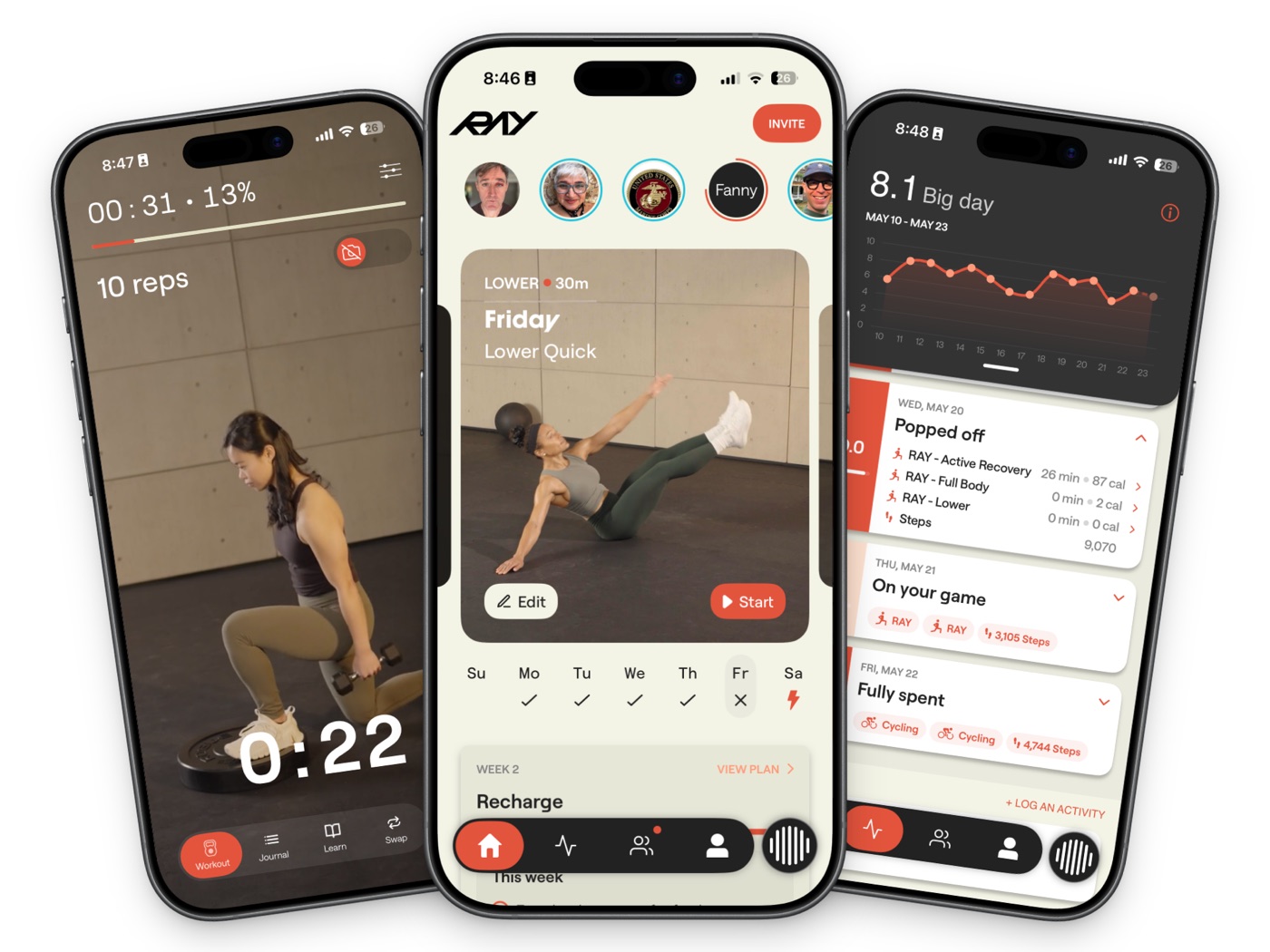
Ray is an AI personal trainer for people who want the workout to adapt around real life. Ray can guide workouts by voice, adjust session length, account for available equipment, and help you keep moving when your schedule changes. Instead of waiting for a human coach to revise the plan later, Ray is built to respond in the moment.
That flexibility is the biggest difference. If you planned a 45-minute gym workout but only have 20 minutes at home, Ray can shift the session. If an exercise is too hard, Ray can help you modify. If you have no equipment, Ray can build around bodyweight work. If you want strength training today and stretching tomorrow, Ray does not treat that as breaking the program.
Ray is also available when motivation is low. It can nudge you, help you start with a smaller workout, and keep the habit alive without turning every missed session into a failure. That matters for beginners, busy parents, travelers, and adults trying to rebuild consistency after years of stop-start fitness plans.
To see the experience in motion, watch this short Ray walkthrough: Ray experience video.
Try Ray free for 1 week if you want flexible coaching before committing to a paid plan.
Side-by-side feature comparison
| Feature | Ray | Future |
|---|---|---|
| Core model | AI personal trainer app | Dedicated human personal trainer through an app |
| Best fit | People who want flexible, lower-cost coaching that adapts to the day | People who want a human relationship and premium accountability |
| Published monthly price checked | Plans start at $19.99/month after trial | $50 first month, then $199/month |
| Trial / intro | 7-day free trial | $50 first month; Future also states cancellation within 30 days for a full refund |
| Workout adaptation | Designed for quick changes to duration, equipment, workout type, and difficulty | Coach can adjust the plan over time through human communication |
| Accountability | App-based nudges, guidance, and repeated availability | Human texts, check-ins, and relationship-based accountability |
| Equipment flexibility | Can support bodyweight, home, travel, or gym contexts | Coach can program around available equipment |
| Human connection | No dedicated human trainer relationship | Core feature of the product |
| Best “failure mode” coverage | When your day changes and you need to adapt now | When you need a person to keep you emotionally accountable |
Real-world scenarios
Scenario 1: you are busy and inconsistent
If your biggest problem is that workouts keep getting interrupted by work, kids, travel, or low energy, Ray is usually the better fit. The goal is not to preserve a perfect plan. The goal is to keep the habit alive with a workout that fits today.
Scenario 2: you need a person to care whether you show up
If you already know that you only stay consistent when a real person checks in, Future has the advantage. A human trainer can build social commitment in a way an AI app cannot fully replicate. That is the strongest honest case for Future.
Scenario 3: you want strength training without intimidation
Ray is a strong fit if you want to build strength but do not want to design every workout yourself. App Store reviewers repeatedly mention being able to set workouts for home or gym, adjust exercises that feel too difficult, and choose workout duration and type. That kind of flexibility lowers the barrier to starting.
Scenario 4: you are choosing between Future and a cheaper app
If the decision is mostly about cost, Ray is the more accessible starting point. You can try Ray free for 7 days and then continue at a much lower monthly price than Future’s $199/month subscription. If you later discover that you truly need human accountability, you can still consider Future.

Best-for and not-for caveats
Ray is best for
- busy adults who need workouts to flex around real life
- people who want a lower-cost alternative to premium human coaching
- beginners who want guided strength training without having to plan everything
- travelers, parents, and inconsistent exercisers who need shorter or equipment-light options
- people who prefer app-based coaching and repeated nudges over a human trainer relationship
Ray is not for
- people who specifically need a human trainer texting them personally
- athletes who require sport-specific coaching from a human specialist
- users who want a trainer to deeply discuss life context every week
- anyone who values human accountability more than cost, flexibility, or instant adaptation
Future is best for
- people who are motivated by a real trainer relationship
- users who can afford $199/month for premium coaching
- people who want a human to design the plan and check in over time
- someone who has tried apps and knows the missing piece is personal accountability
Future is not for
- price-sensitive users
- people who mainly need in-the-moment workout changes
- users who do not want to rely on human messaging to adjust their plan
- people looking for a low-friction app they can try before paying premium coaching prices
Which should you choose?
Choose Future if the human trainer relationship is the product for you. If a dedicated coach texting you, asking about your week, and refining your plan is what will make you train consistently, Future’s premium price may make sense.
Choose Ray if you want a coach-like experience that is easier to start, easier to afford, and easier to adapt. Ray is built for the messy reality of adult fitness: shorter workouts, changing equipment, missed sessions, low-energy days, travel, and the need to keep going without renegotiating the whole plan.
For most people comparing the two, Ray is the better first step. It costs less, has a free trial, and solves the everyday friction that causes many workout plans to fail. Future is the better choice when you already know that human accountability is the non-negotiable ingredient.
Frequently asked questions
Is Ray better than Future?
Ray is better if you want flexible AI coaching at a lower price. Future is better if you specifically want a dedicated human trainer and can afford premium monthly coaching. The better choice depends on whether your main need is instant adaptation or human accountability.
How much does Ray cost compared with Future?
Ray’s official site says plans start at $19.99/month after a 7-day free trial, with discounts for longer plans. Future’s official site lists $50 for the first month, then $199/month. Pricing can change, so check both official pages before subscribing.
Does Future use a real human trainer?
Yes. Future’s core model is a dedicated human coach who creates your program, checks in, monitors progress, and refines your plan. That human relationship is the main reason to choose Future.
Does Ray replace a personal trainer?
Ray can replace many practical parts of personal training for people who need guidance, structure, workout adaptation, and consistency at a lower price. It does not replace the emotional relationship, personal texting, or specialist judgment of a dedicated human trainer. For more detail, read Can AI Replace a Personal Trainer?.
Can Ray adapt workouts if I only have 20 minutes?
Yes. That is one of the main reasons to choose Ray. If your time, energy, equipment, or workout preference changes, Ray is designed to help you adjust instead of abandoning the session.
Is Ray good for beginners?
Ray is a strong fit for beginners who want guided strength training without designing their own plan. It is especially useful if you want the app to account for your available time and equipment. If you want to compare more AI coaching options, read our guide to the best AI personal trainer apps.