· 13 min read
Type 2 Diabetes Can Cost You Muscle. Here's How to Build It Back

Colin Raney
Co-founder & CEO of Ray, NASM-CPT · Evidence reviewed November 3, 2026
If you've been told to exercise for type 2 diabetes or prediabetes, you've probably heard "walk more" and not much else. Walking helps. But that advice leaves out what keeps you climbing stairs, carrying groceries and getting up off the floor for decades: muscle. In US survey data from 2020 and 2022, only 15.3% of adults with diabetes met the recommendation for muscle-strengthening activity, compared with 32.4% of adults without diabetes (raw figures, and age may explain part of the gap). The CDC counts 40.1 million people with diabetes and 115.2 million adults with prediabetes, so that's a lot of people missing out.
Direct answer: If you have type 2 diabetes, strength training belongs in your plan as a must-do. People with type 2 tend to lose muscle faster and are more likely to have mobility problems, and strength training builds muscle and strength back. Two or three 30-minute sessions a week is enough to start, on top of your walking and your care plan. It helps your blood sugar too, as an add-on to your treatment.
This guide covers type 2 diabetes and prediabetes. Type 1, gestational and childhood diabetes are different enough that it doesn't apply to them.
Why muscle is the part you can't skip
In a six-year study of 2,675 older adults, people with type 2 diabetes lost more lean mass in their arms and legs combined than people without it. Thigh muscle shrank twice as fast in older women with diabetes as in older women without it. The difference in men's thigh muscle wasn't significant.
You feel that loss in daily life. A review of 26 studies linked diabetes to about a 50% higher risk of mobility problems and about an 80% higher risk of trouble with basic daily activities. Among 9,249 women aged 67 and older, those with diabetes had higher odds of falling more than once a year, about 1.7 times without insulin and 2.8 times with it. Other risk factors explained most of the gap for women not on insulin.
These studies show links in mostly older adults, and they don't prove diabetes alone is the cause. If you're 40 or 50, read them as your reason to start now, while you've got the most to protect.
What strength training gives you back
Muscle responds, and that's the good news. A 2025 review of 19 randomized trials in older adults with type 2 found strength training increased lean mass and muscle strength and reduced waist size. Body weight didn't change, so the scale can miss all of it.
The trials show what that looks like. In a 16-week trial of 62 older Latino adults, 40 of them women, people who did supervised strength training three times a week gained 1.2 kilograms of lean mass, about 2.6 pounds, while the control group lost 0.1. In a 16-week home trial, strength rose 20% to 37%.
Everyday function improves too. In a supervised home trial of 100 pre-frail adults averaging 66, 12 weeks of band training improved grip strength, chair stands and walking time compared with routine care. In a trial of 298 adults over 70 who were frail or close to it, a 16-week program of strength training, nutrition education and better diabetes care improved frailty and physical performance when checked 18 to 24 months in, mostly among those close to frail.
It takes less time than you think
The workout below takes about 30 minutes. Do it two or three times a week and you've spent 60 to 90 minutes, at home, with no drive to a gym. That's less than the 150 minutes of aerobic activity the American Diabetes Association also recommends, and eight moves cover your whole body.
Research on how much it takes points the same way. A review of 16 long-term studies found the lowest risk of early death, heart disease and cancer at about 30 to 60 minutes of muscle-strengthening activity a week, 10% to 20% lower than doing none. More time wasn't clearly better for those outcomes.
Those studies only observed people, who may have been healthier in other ways, and they didn't focus on people who already have diabetes. Still, an hour a week is a realistic place to start. Several of the trials above used three sessions a week, so build toward that.
Blood sugar, and why to keep walking
Strength training helps your blood sugar too. Over months, reviews of randomized trials put the average A1c drop between about 0.3 and 0.6 points (Bärg 2025, Jansson 2022, Feng 2025, Zhang 2026). Results vary, and one review notes that most of its programs were supervised. Think of it as adding to your treatment, not replacing it.
Don't drop your walks. In DARE, 251 adults aged 39 to 70 were assigned to aerobic training, strength training, both or no exercise. Each kind of training lowered A1c compared with no exercise, and doing both lowered it further, though that group also spent more total time exercising. In HART-D, which followed 262 sedentary adults for nine months, only the combined group saw a statistically significant A1c drop compared with a group offered stretching classes.
So the strongest case is adding strength to the movement you already do. You keep the walking, and you get the muscle and strength that walking alone may not build.
Training at home
You don't need a gym to get stronger. In a 32-week Kuwaiti trial of 120 adults, 38% of them women and averaging 60, the home group finished with more lean mass in their legs and arms than the usual care group, could do more push-ups and had less liver fat, even though they completed only about half their sessions.
A1c results at home are weaker. That trial and the 16-week home trial above found no significant change, so judge home training by what it builds: strength, muscle and how easily you move. Get real weights, make them heavier over time and keep the sessions on your calendar.
If you have prediabetes
The evidence here is about risk. It comes from women, in studies not limited to people with prediabetes. Among 33,463 women averaging about 63, any strength training was linked to a 30% lower rate of type 2 diabetes, though that lost statistical significance once the authors accounted for body weight. Among 99,316 US nurses aged 36 to 81, 60 to 150 minutes of resistance exercise a week was linked to a 25% lower rate, or about 18% after accounting for body weight.
Both studies relied on self-reports, and no trial I found tested strength training with new diabetes as the outcome. So what I can say is that it's linked to lower risk. The muscle and strength you build are yours either way.
A beginner full-body workout
The American Diabetes Association's 2026 Standards of Care recommend two to three resistance sessions a week on nonconsecutive days, plus at least 150 minutes of moderate to vigorous aerobic activity. The ADA's 2016 position statement and the American College of Sports Medicine's 2022 consensus statement suggest 8 to 10 exercises and one to three sets of 10 to 15 reps, with the ADA starting beginners at a moderate intensity.
This workout is built to fit those numbers, but the choices are mine as a trainer. It isn't a tested diabetes protocol. You need a couple of dumbbells, a sturdy chair and a counter. It should take about 30 minutes.
Move | How to do it | Sets and reps |
|---|---|---|
Chair squat | Sit down and stand up from a chair, holding a dumbbell at your chest once it's easy | 2 sets of 10 to 15 |
Incline push-up | Hands on a counter or sturdy table, body straight | 2 sets of 10 to 15 |
Romanian deadlift | Two dumbbells, hinge at your hips with a long back | 2 sets of 10 to 15 |
One-arm row | One hand on the chair, pull a dumbbell to your ribs | 2 sets of 10 to 15 per side |
Step-up | A low, sturdy step, no weight at first | 2 sets of 10 per side |
Shoulder press | Two dumbbells, seated or standing | 2 sets of 10 to 15 |
Glute bridge | On your back, feet flat, raise your hips | 2 sets of 10 to 15 |
Dead bug | On your back, slowly lower the opposite arm and leg | 2 sets of 10 per side |
Rest about a minute between sets. Pick a weight where the last few reps are hard but your form holds, and you could still do a couple more. Breathe out on the hard part of every rep.
Rather have someone walk you through it? Ray coaches each session out loud with whatever weights you have. Try your first week free.
How to progress and fit it into your week
Start with two sessions, such as Monday and Thursday. Once that feels routine, go to three, such as Monday, Wednesday and Friday. Walk or do other aerobic work on the days in between, working toward the ADA's 150 minutes.
If two sets feels like a lot at first, do one. When you can do 15 reps on every set for two sessions in a row, go up to the next weight. The ADA statement says heavier work can drop to 8 to 10 reps, and that's what you'd expect after a jump in weight. Build back up to the top of the range, go up again, and add a third set once the heavier weight feels settled.
Timing can help too. The ACSM statement says exercising after a meal can blunt glucose spikes. If you use insulin or a sulfonylurea, ask your care team about timing first.
Keep track of the weights you use. Your numbers going up is the result you control between A1c tests.
If you're also on a GLP-1, our guide to strength training progress on GLP-1s goes further, and if you're brand new to strength training, start with starting fitness after 50 or strength training after 40.
How Ray helps you keep doing this
Keeping this going is the hard part, and that's what we built Ray for.
You choose your training days, and Ray coaches each session out loud with your reps and rest, hands-free. It works with what you have, including dumbbells, a kettlebell or nothing. You grab the weight and log it, and Ray uses that history to guide when to go up. Tell it about a joint or movement limit your doctor flagged and it applies that across every workout. If a move hurts, say so and it swaps it. You can also turn on low impact or ask for an easier session.
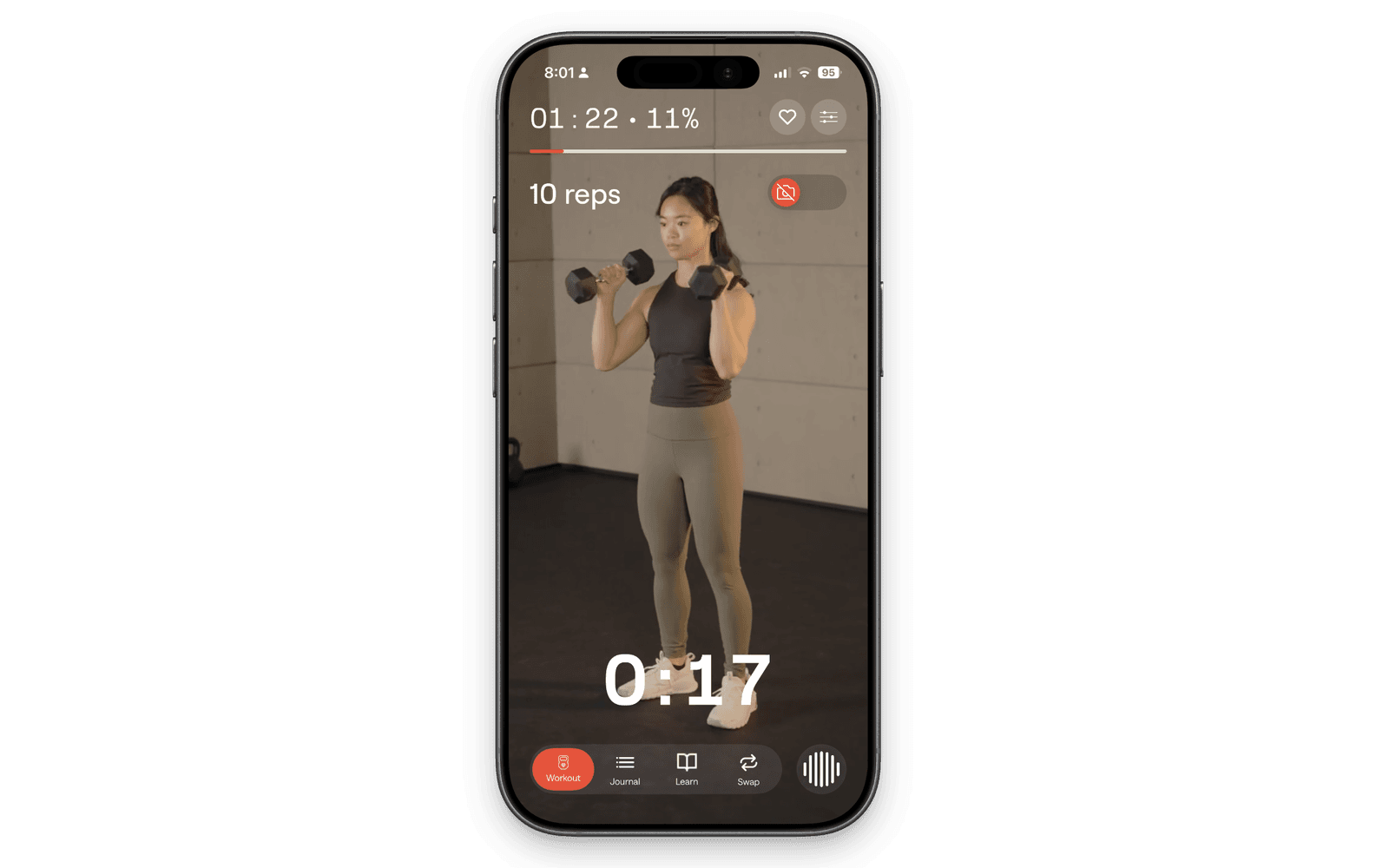
The limits matter here. Ray doesn't read your glucose or A1c, and there's nowhere to record medication. It doesn't give medical advice, and it won't recognize low blood sugar or stop the workout for you, so watching for that stays with you. It doesn't enforce rest days, so pick nonconsecutive ones. Reps are set by each workout and may not match 10 to 15.
Ray is on iPhone at $19.99/mo, $39.99 every three months or $119.99 a year, checked November 1, 2026, and your first week is free.
Ready to add strength to your plan? Get your plan from Ray.
Know your limits and take care of yourself
You don't have to press hard to get this done. Moderate effort is where the guidance starts, and some days easy is the right call. An easy session still counts.
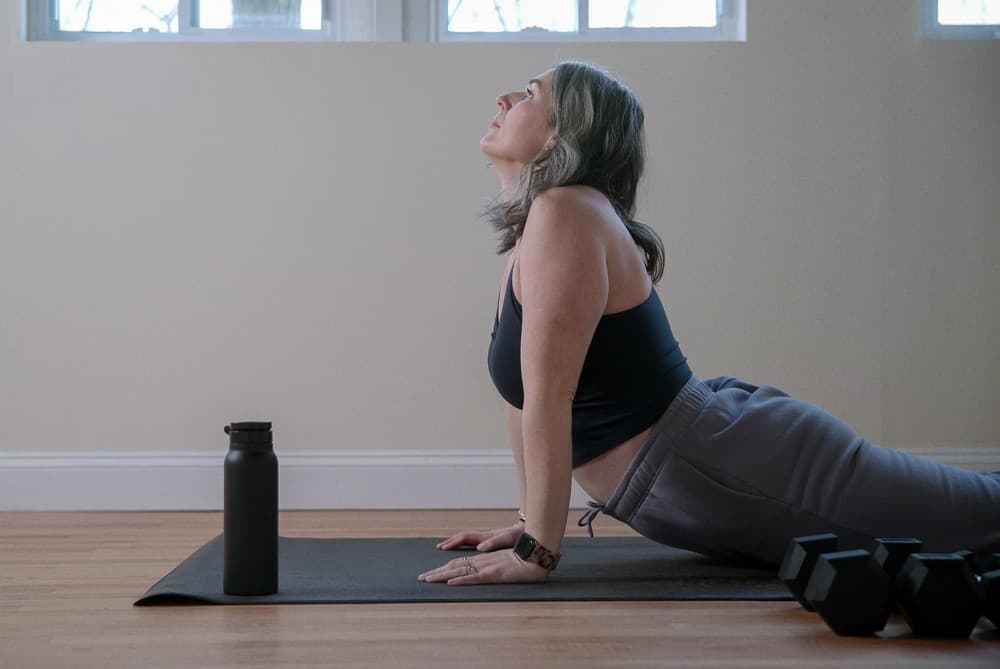
Go easier when you slept badly, you're still sore or you just feel off. Use lighter weights, do one set instead of two or rest longer. Soreness for a day or two is normal when you start. If a move causes sharp or joint pain, swap it.
Skip the session when you're sick or when your blood sugar is outside the range your care team gave you.
Stop for the day if you feel shaky, sweaty, dizzy or confused. The CDC lists those among the common signs of low blood sugar, so follow your care team's plan. Some people don't notice any signs, so ask how often to check, and keep something fast-acting nearby. For chest pain, trouble breathing or sudden changes in your vision, stop and get medical help right away.
Talk with your care team when you start. It's usually a quick conversation. Tell them you're starting strength training, ask what blood sugar reading should mean you skip a session, and bring up anything below that sounds like you. These points come from the American Diabetes Association (ADA), since I'm a trainer and no clinician reviewed this guide.
- If you take insulin or a sulfonylurea: Exercise can bring your blood sugar down, sometimes for several hours afterward. The ADA says you may need some carbs if you're under 90 mg/dL before a session, so ask what they'd like you to do. Any change to your dose is their call.
- If diabetes has affected your eyes: With more advanced retinopathy, the ADA says hard efforts may be off limits because they can harm your eyes. Your eye doctor can tell you if that's you, and which moves to skip, such as ones where your head goes down.
- If your feet are numb or you have a sore: The ADA's advice is good shoes and a look at your feet every day. If you have a foot injury or sore, stick to moves that keep weight off your feet until it's healed.
- If you have heart concerns or high blood pressure: Ask where to start, and keep breathing through every rep, because the ADA says to avoid holding your breath with high blood pressure. If you have nerve damage that affects your heart rate or blood pressure, it advises getting your heart checked before you push harder than you're used to.
Sources
- Onufrak S, et al. Physical activity according to diabetes and metropolitan status, U.S., 2020 and 2022. American Journal of Preventive Medicine, 2024. PMC11284528
- CDC. National diabetes statistics. Updated 2026. CDC
- Bärg M, et al. Effects of home- and gym-based resistance training on glycemic control in patients with type 2 diabetes mellitus. Diabetology & Metabolic Syndrome, 2025. PMC12175443
- Jansson AK, et al. Effect of resistance training on HbA1c in adults with type 2 diabetes and the moderating effect of changes in muscular strength. BMJ Open Diabetes Research & Care, 2022. PMC8915309
- Park SW, et al. Excessive loss of skeletal muscle mass in older adults with type 2 diabetes. Diabetes Care, 2009. PubMed 19549734
- Wong E, et al. Diabetes and risk of physical disability in adults. Lancet Diabetes & Endocrinology, 2013. PubMed 24622316
- Schwartz AV, et al. Older women with diabetes have a higher risk of falls. Diabetes Care, 2002. PubMed 12351472
- Feng M, et al. The efficacy of resistance exercise training on metabolic health, body composition, and muscle strength in older adults with type 2 diabetes. Diabetes Research and Clinical Practice, 2025. PubMed 40090422
- Castaneda C, et al. A randomized controlled trial of resistance exercise training to improve glycemic control in older adults with type 2 diabetes. Diabetes Care, 2002. PubMed 12453982
- Hu L, et al. Psychophysiological effects of a supervised home-based resistance band exercise program in pre-frail older patients with type 2 diabetes mellitus. BMC Sports Science, Medicine and Rehabilitation, 2025. PubMed 40121486
- Laosa O, et al. Long-term frailty and physical performance transitions in older people with type-2 diabetes: the MIDFRAIL randomized clinical study. Journal of Nutrition, Health & Aging, 2025. PubMed 39954533
- Momma H, et al. Muscle-strengthening activities are associated with lower risk and mortality in major non-communicable diseases. British Journal of Sports Medicine, 2022. PubMed 35228201
- Zhang X, et al. The impact of resistance training on the atherogenic index of plasma and cardiometabolic health-related indicators in middle-aged and older adults with type 2 diabetes. Maturitas, 2026. PubMed 41950771
- Sigal RJ, et al. Effects of aerobic training, resistance training, or both on glycemic control in type 2 diabetes (DARE). Annals of Internal Medicine, 2007. PubMed 17876019
- Church TS, et al. Effects of aerobic and resistance training on hemoglobin A1c levels in patients with type 2 diabetes (HART-D). JAMA, 2010. PMC3174102
- Al Ozairi E, et al. The effect of home-based resistance exercise training in people with type 2 diabetes. Diabetes/Metabolism Research and Reviews, 2023. PubMed 37330638
- Plotnikoff RC, et al. Multicomponent, home-based resistance training for obese adults with type 2 diabetes. International Journal of Obesity, 2010. PubMed 20531348
- Shiroma EJ, et al. Strength training and the risk of type 2 diabetes and cardiovascular disease. Medicine & Science in Sports & Exercise, 2017. PMC5161704
- Grøntved A, et al. Muscle-strengthening and conditioning activities and risk of type 2 diabetes: a prospective study in two cohorts of US women. PLoS Medicine, 2014. PMC3891575
- American Diabetes Association Professional Practice Committee. Facilitating positive health behaviors and well-being to improve health outcomes: Standards of Care in Diabetes 2026. Diabetes Care, 2026. PMC12690188
- Colberg SR, et al. Physical activity/exercise and diabetes: ADA position statement. Diabetes Care, 2016. PMC6908414
- Kanaley JA, et al. Exercise/physical activity in individuals with type 2 diabetes: ACSM consensus statement. Medicine & Science in Sports & Exercise, 2022. PMC8802999
- CDC. Low blood sugar (hypoglycemia). 2024. CDC