· 6 min read
A New Study Links Strength Training to Quicker Reactions in Midlife Women

Colin Raney
Co-founder & CEO of Ray, NASM-CPT · Evidence reviewed November 3, 2026
Most of us start strength training for our muscles. A study published October 27 in *Medicine & Science in Sports & Exercise* suggests a reason you may not have considered, at least for women in midlife. Researchers in Taiwan gave 93 women aged 35 to 63 a set of mental tasks, then compared the results by age and by how the women exercised.
Direct answer: Women who did strength training had quicker reaction times than the other groups in this study, and regular exercisers of any type did better on harder working memory tasks. It's one small study taken at a single point in time, so it can't show that strength training caused those differences. But trials in older adults point in a similar direction, and two strength sessions a week is already the recommendation for all adults. So I'd treat this as one more reason to do it, not as the reason.
What the study found
The women did three kinds of tasks, and the results differed for each.
Reaction time. This is how quickly you respond to a simple signal. Older age went with slower reactions, and that gap was smaller among women who exercised regularly. This is where type of exercise mattered: the strength training group was faster than the aerobic group, the other exercise group and the women who didn't exercise regularly.
Working memory. This is holding information in mind while you use it, like keeping a phone number in your head while you dial. Regular exercisers responded faster, the difference grew as the task got harder, and it came mostly from the older women. Here, type of exercise made no difference.
Planning. Planning performance varied with age, but exercise made no difference at all.
How much weight to give it
This study compared different women at one moment. It didn't assign anyone to train or follow anyone over time. So women who strength train may also differ in ways that affect these tasks, such as sleep, health, work or education.
The authors call midlife a sensitive window for exercise. That's a reasonable idea to test, but a study of this design can't establish it.
I also have to be upfront about what I couldn't read. The full paper is behind a paywall, so this article relies on the published abstract. The abstract doesn't say how many women were in the strength training group, how the researchers defined regular exercise or how many milliseconds separated the groups. So I can't tell you how big the reaction time difference was, or whether you'd notice it in daily life.
What it gives us is a good question to test, in women younger than most of the research below.
What the wider research shows
The stronger evidence comes from trials that assigned people to exercise, and most of those studied older adults.
A review of 39 studies in adults over 50 found exercise improved cognitive function, and aerobic training, strength training, multicomponent training and tai chi each helped. A 2022 analysis of 44 randomized trials with 4,793 older adults found strength training had the strongest effects of the exercise types it compared. A 2025 analysis of 58 trials in healthy adults 60 and older split the credit: strength training led for overall cognition, mind-body exercise for working memory and aerobic exercise for memory.
So no single type wins everything, and doing more than one kind makes sense.
These trials didn't study women in their 40s and 50s, so applying them to you is a reasonable step, but it's still a step.
Two trials worth knowing
In a 12-month trial of 155 women aged 65 to 75, women doing strength training once or twice a week improved on an attention test by 12.6% and 10.9%, while a balance and tone group slipped by 0.5%. The full paper found no significant difference between the groups in working memory. The strength training groups also had a larger drop in whole brain volume than the balance and tone group, and that finding doesn't have a simple reading.
In a trial of 309 Danish adults aged 62 to 70, a year of supervised training at heavy or moderate intensity lowered predicted brain age, a measure estimated from brain scans, by about 1.4 to 2.3 years. The group that didn't exercise saw no significant change. The authors say the clinical meaning still needs testing, and that their findings apply to healthy older adults like these.
Neither trial proves you'll think faster. Together they make it reasonable to expect that strength training does something for the brain.
If you've noticed changes in your focus or memory
Many women in this age range notice small lapses, and there's research on that too. A study following 2,362 midlife women for four years found that women learned less well on repeated tests during perimenopause than they had before it. That learning returned to its earlier level after menopause, and the authors suggest these difficulties may be time-limited.
That's useful to know, and it's separate from the exercise question. None of the research here tests strength training as a treatment for those lapses, so I won't tell you it will fix them.
If changes in your memory or thinking worry you, or they're getting in the way of daily life, bring them up with your doctor. A trainer can't sort those out, and neither can a workout plan.
A simple way to start
You don't need a new plan for your brain. The CDC already recommends muscle-strengthening activity on at least two days a week, working all your major muscle groups, plus 150 minutes of moderate aerobic activity. Since working memory showed no difference by exercise type, keep your walks.
Here's how I'd start, and these are my choices as a trainer, not the study's protocol:
- Twice a week. Monday and Thursday works. Allow about 30 minutes.
- Five moves. Chair squat, incline push-up, Romanian deadlift, one-arm row and shoulder press.
- Two sets of 10 to 12 reps. Choose a weight where the last few reps are hard but your form holds.
- Go heavier over time. When you hit 12 reps on every set for two sessions in a row, go up to the next weight.
If you're brand new to this, strength training after 40 goes deeper, and strength training in menopause covers that stage.
The muscle and strength you build are worth having whatever this research ends up showing.
How Ray helps you keep it regular
The study's finding was about regular exercise, and regular is the hard part. That's what we built Ray for.
You choose your training days, and Ray coaches each session out loud with your reps and rest, hands-free. It works with what you have, including dumbbells, a kettlebell or nothing. You log the weight you use, and Ray uses that history to guide when to go up. If a move hurts, say so and it swaps it.
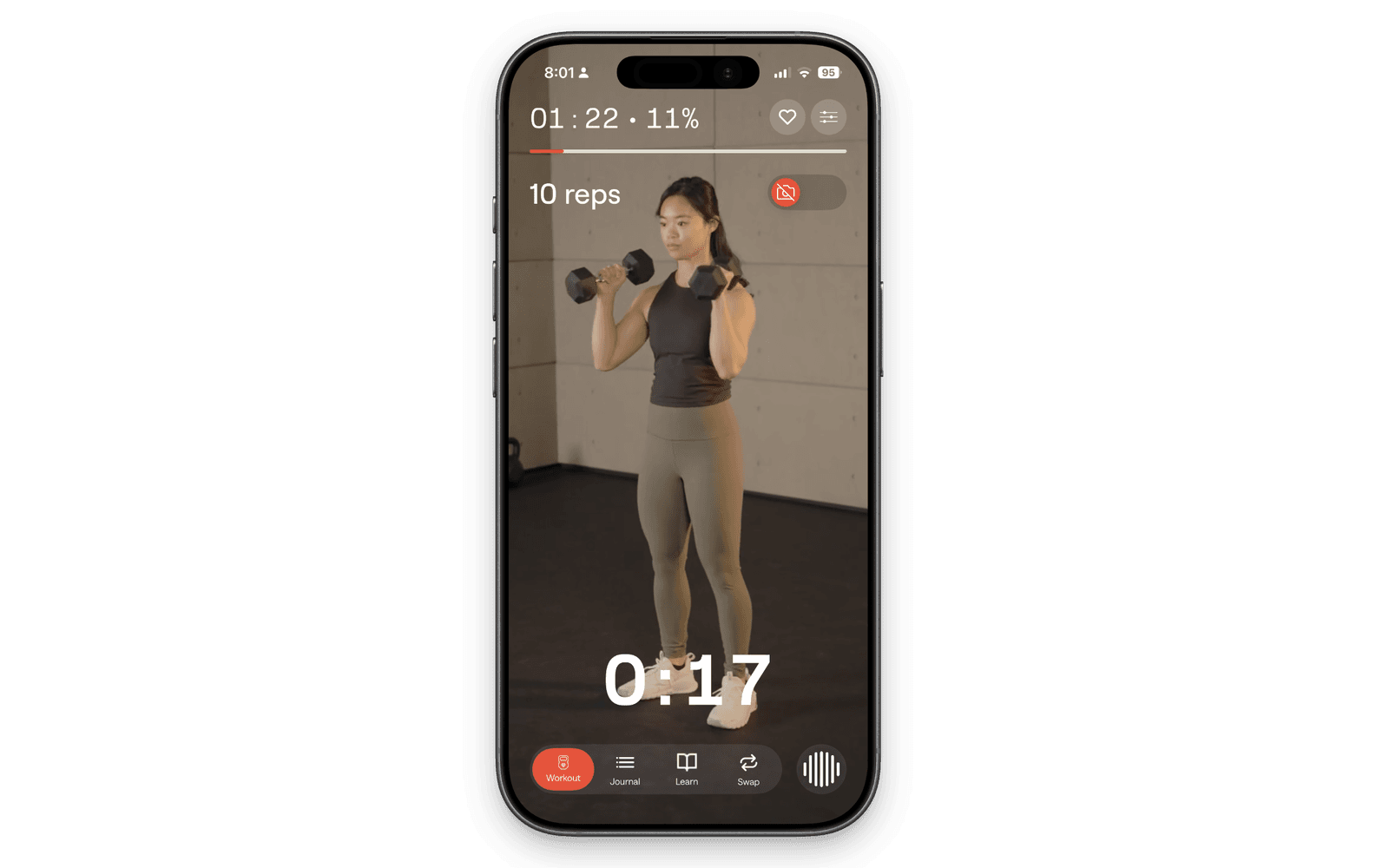
To be clear about the limits, Ray doesn't test or track reaction time, memory or anything else about your thinking. We make no claim that using Ray improves them. It helps you do the training.
Ray is on iPhone at $19.99/mo, $39.99 every three months or $119.99 a year, checked November 3, 2026, and your first week is free.
Ready to make strength training a regular thing? Get your plan from Ray.
Sources
- Wong PL, Chen YL, Juan CH. Regular exercise moderates age-related cognitive differences in midlife women: domain-specific effects on processing speed and working memory. Medicine & Science in Sports & Exercise, 2026. PubMed 42934964
- Northey JM, et al. Exercise interventions for cognitive function in adults older than 50: a systematic review with meta-analysis. British Journal of Sports Medicine, 2018. PubMed 28438770
- Gallardo-Gómez D, et al. Optimal dose and type of exercise to improve cognitive function in older adults: a systematic review and bayesian model-based network meta-analysis of RCTs. Ageing Research Reviews, 2022. PubMed 35182742
- Han H, et al. Optimal exercise interventions for enhancing cognitive function in older adults: a network meta-analysis. Frontiers in Aging Neuroscience, 2025. PubMed 40717897
- Liu-Ambrose T, et al. Resistance training and executive functions: a 12-month randomized controlled trial. Archives of Internal Medicine, 2010. PubMed 20101012, PMC3448565
- Gonzalez-Gomez R, et al. Randomized controlled trial of resistance exercise and brain aging clocks. GeroScience, 2026. PMC13356001
- Greendale GA, et al. Effects of the menopause transition and hormone use on cognitive performance in midlife women. Neurology, 2009. PubMed 19470968
- CDC. Adult activity: an overview. 2023. CDC